
Why You Need a Plan to Save Money for Your Trip
Save money for your trip before you book anything — that’s the single most important step most travelers skip.
Here’s a quick answer if you’re in a hurry:
How to save money for a trip (fast summary):
- Set a total budget — add up flights, lodging, food, activities, and add a 10-15% buffer
- Open a dedicated savings account — label it with your trip name to protect the funds
- Automate transfers — move money into that account on payday, every payday
- Cut 2-3 spending leaks — subscriptions, takeout, impulse buys
- Use windfalls wisely — drop tax refunds and bonuses straight into your travel fund
- Leverage rewards — use credit card points and cashback to offset costs
- Book at the right time — 1-3 months ahead for domestic, 2-8 months for international
A vacation is supposed to help you rest and recharge. But without a savings plan, the cost can do the opposite — leaving you stressed and in debt long after you’ve come home.
The numbers make this real. A one-week U.S. vacation costs the average solo traveler around $1,991. For a family of four, that jumps to $3,609. And that’s before you factor in holiday price surges, where airfares can run 41% higher than flights booked six months out during non-peak times.
The good news? None of this has to stop you from going. With the right system, saving for a trip becomes automatic — less about willpower, more about setup.
This guide walks you through exactly how to do it, step by step.
Building a Realistic Budget for Your Dream Vacation
Before we can save money for your trip, we have to know exactly how much “enough” actually is. Many travelers fail because they only save for the “big” things like flights and hotels, then find themselves swiping credit cards for $15 airport sandwiches and $40 taxi rides.
To create a budget that doesn’t break, we recommend splitting your costs into two categories:
- Tier 1 (The Essentials): These are non-negotiable costs. Think flights, accommodation, travel insurance, visas, and basic transportation.
- Tier 2 (The Splurges and Daily Life): This includes museum tickets, that fancy dinner you saw on Instagram, souvenirs, and daily coffee runs.
A critical tip we always share is to add a 15% buffer to your total estimate. This isn’t for a shopping spree; it’s for the “oops” moments—like a missed train or a price jump in airfare. If you don’t use it, congrats! You’ve already started saving for your next adventure.
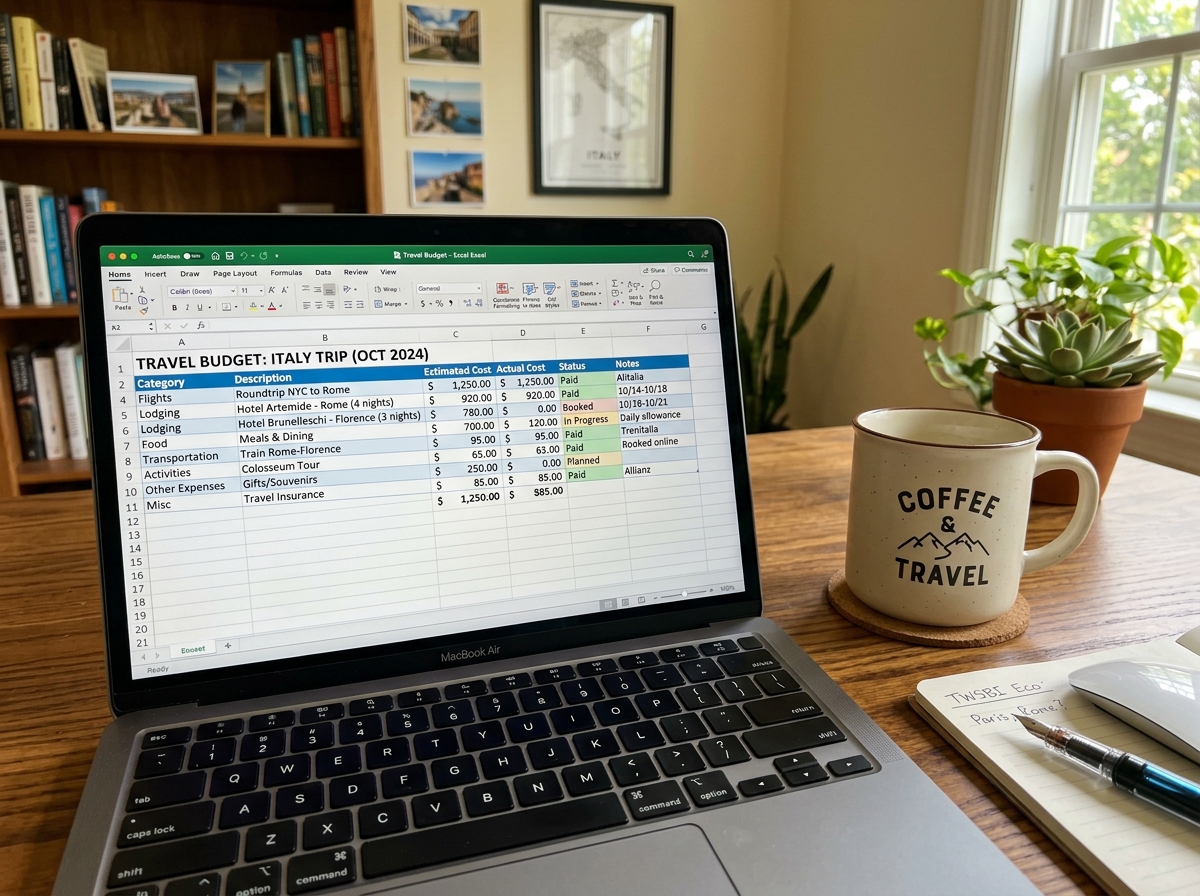
When calculating your costs, consider the type of trip you are taking. A solo backpacker in Southeast Asia has a very different financial profile than a family of four heading to Disney World. Here is a quick comparison of what you might expect to spend:
| Trip Type | Estimated Weekly Cost (Low-Mid Range) | Key Expense Drivers |
|---|---|---|
| Solo Traveler (Domestic) | $1,200 – $1,900 | Solo room rates, dining out |
| Family of Four (Domestic) | $3,500 – $4,500 | Multiple flights, larger lodging, theme park tickets |
| International (Couple) | $4,000 – $6,000 | Long-haul flights, currency exchange, visas |
To keep these numbers from ballooning, check out our guide on Ways to Reduce Travel Expenses for practical ways to trim the fat from your itinerary.
Smart Banking Strategies to Save Money for Your Trip
Once you have a target number, you need a place to put that cash where you won’t touch it. Keeping your travel fund in your main checking account is a recipe for “accidentally” spending your flight money on a new pair of shoes.
We are big fans of mental accounting. This is the psychological trick of giving your money a specific job. The best way to do this is to open a dedicated high-yield savings account (HYSA).
Why an HYSA? Because while your money sits there, it earns interest. In the current market, many HYSAs offer 4% to 5% APY. If you’re saving $5,000 over a year, that’s an extra $200 or $250 just for letting your money sit still.
Pro Tip: Give your account a name. Instead of “Savings 2,” call it “Italian Coast 2026” or “The Great Safari.” Research shows that when we label an account with a specific goal, we are much less likely to “raid” it for non-essential purchases. It becomes “precious” to us. For more foundational advice, see our Budget Travel Tips for Beginners.
How to Save Money for Your Trip with Automation
The secret to effortless saving is removing your own willpower from the equation. If you have to remember to transfer money every month, you’ll eventually forget—or talk yourself out of it.
Set up an automatic transfer that triggers the morning your paycheck hits your account. By moving the money before you even see it “available” in your balance, you adapt your spending habits to what’s left. This “pay yourself first” model is backed by behavioral science; automated savers consistently accumulate more wealth than those who save manually, regardless of their income level.
Using Windfalls to Save Money for Your Trip Faster
Sometimes, life gives you a financial “bonus.” Instead of letting a tax refund, a work bonus, or a cash gift from a relative disappear into your daily spending, reroute it immediately.
We call these windfalls. If you receive a $1,000 tax refund, dropping it straight into your “Italian Coast” account could shave months off your saving timeline. However, we do suggest a quick check: if you have high-interest credit card debt, pay that off first. The interest you save on debt is often higher than the interest you’ll earn in savings, which ultimately helps you travel on a tight budget more effectively in the long run.
Cutting Expenses and Boosting Your Travel Fund
To save money for your trip at an accelerated pace, you need to look at your current “spending leaks.” Most of us are paying for at least 2-4 subscriptions we don’t use.
Perform a subscription audit. Cancel the streaming service you haven’t watched in a month and the gym membership you stopped using in February. Redirect that $50 or $100 a month directly into your travel pot.
Another powerful strategy is the No-Spend Month. Pick a month where you only buy essentials (groceries, rent, utilities). No dining out, no new clothes, and no “target runs.” It’s a challenge, but the results are often staggering—many people find they can save an extra $300 to $500 in just 30 days.
If cutting isn’t enough, it’s time to boost your income. We love these side hustles for travel funding:
- Selling unused items: Use online marketplaces to clear out your closet. One person’s “trash” really is another’s treasure.
- Pet sitting or dog walking: Great for animal lovers and usually pays in cash that can go straight to the fund.
- Renting out space: If you have a spare room or even a parking spot in a busy city, these can be goldmines.
Why go through all this trouble? Because science says experiences make us happier than things. Scientific research on the happiness value of experiences vs. possessions from Thomas Gilovich at Cornell University suggests that the joy we get from buying a physical object fades as we get used to it, but the memories of a trip actually get better over time. You aren’t just buying a plane ticket; you’re buying long-term happiness.
Booking Hacks: Timing and Seasonality for Maximum Savings
Timing is everything when you want to save money for your trip. If you book a flight to Europe in July, you’re going to pay a premium. If you go in May or September—the shoulder season—you get the same beautiful weather with 30% lower prices and half the crowds.
Here are the gold-standard booking windows we recommend:
- Domestic Flights: 1 to 3 months in advance.
- International Flights: 2 to 8 months in advance.
The Midweek Rule: Flying on a Tuesday or Wednesday is almost always cheaper than flying on a Friday or Sunday. Airlines know that business travelers and weekend-warriors dominate the bookends of the week, so they drop prices in the middle to fill seats.
When it comes to lodging, don’t just look at the price of the room. A “cheap” hotel five miles outside of town might end up costing you more in Uber fees than a slightly pricier hotel in the city center. We always suggest looking for places with kitchenettes. Being able to cook just one meal a day (like breakfast) can save a family of four over $500 a week. For more on this, read our Tips to Save Money on Accommodation.
Leveraging Rewards and Minimizing On-the-Road Costs
Once you are actually on your trip, the goal is to keep your savings in your pocket. This starts with travel hacking. If you use a credit card for your daily expenses, ensure it’s a travel rewards card.
Many cards offer:
- Sign-up bonuses: These can often cover a round-trip domestic flight.
- No foreign transaction fees: This saves you 3% on every single purchase abroad.
- TSA PreCheck/Global Entry credit: These programs save you hours at the airport. In fact, 99% of TSA PreCheck passengers waited less than five minutes in early 2025.
Another favorite FinanceZora tip is “Grocery Store Tourism.” Instead of eating every meal at a restaurant, visit a local supermarket. It’s a great way to see how locals actually live, and you can pick up high-quality snacks, bread, and cheese for a fraction of the cost of a tourist-trap cafe.
Finally, pack light. Checked bag fees are now hovering around $30-$60 per bag. If you can fit everything into a carry-on, you save money and time at the luggage carousel. Use the 10-$10 rule: if you think you might need something, but it costs less than $10 and takes less than 10 minutes to find at your destination, leave it at home. Check out How to Travel Light and Save Money for more packing hacks.
Frequently Asked Questions about Saving for Travel
How do I calculate costs for different trip types?
Start with the “Big Three”: Transportation, Lodging, and Food. For solo travelers, your biggest expense is often lodging since you aren’t splitting the bill. For families, transportation is the killer. Use tools like Skyscanner for flights and Booking.com for hotels to get real-time estimates. Always research the “daily cost of living” for your destination—Paris is much more expensive than Prague! We have more specific advice in our Cheap Travel Hacks for Solo Travelers.
Should I travel during off-season or shoulder season?
We almost always recommend shoulder season (Spring and Autumn). The off-season (like Winter in Northern Europe) can be very cheap, but many attractions might be closed, and the weather can be miserable. Shoulder season offers the “Goldilocks” zone: lower prices than Summer, but better weather than Winter. If you are looking for a deal right now, see How to Find Last Minute Flight Deals.
What common mistakes should I avoid when saving?
The biggest mistake is raiding the fund. If your car breaks down, don’t take the money from your “Japan 2026” account. This is why you need a separate Emergency Fund. Another mistake is ignoring “hidden” fees like resort fees, baggage fees, and ATM withdrawal fees. These can easily add $200-$300 to a week-long trip. For more pitfalls to avoid, read Ways to Reduce Travel Expenses 2.
Conclusion
At FinanceZora, we believe that everyone deserves the chance to explore the world without the shadow of debt hanging over them. By being intentional with your budget, automating your savings, and using smart booking hacks, you can turn a “someday” dream into a “next Tuesday” reality.
The goal isn’t just to save money for your trip—it’s to create a sustainable financial habit that allows you to travel again and again. Start small, stay consistent, and don’t forget to pack your curiosity (and maybe some budget-friendly gear we recommend).
Ready to start planning? Explore our top budget-friendly destinations and find your next adventure today!
