
What Are Baggage Delay Insurance Claims (and How Do You Get Paid)?
Baggage delay insurance claims are how travelers get reimbursed for essential purchases — like clothing and toiletries — when an airline fails to deliver their checked bags on time.
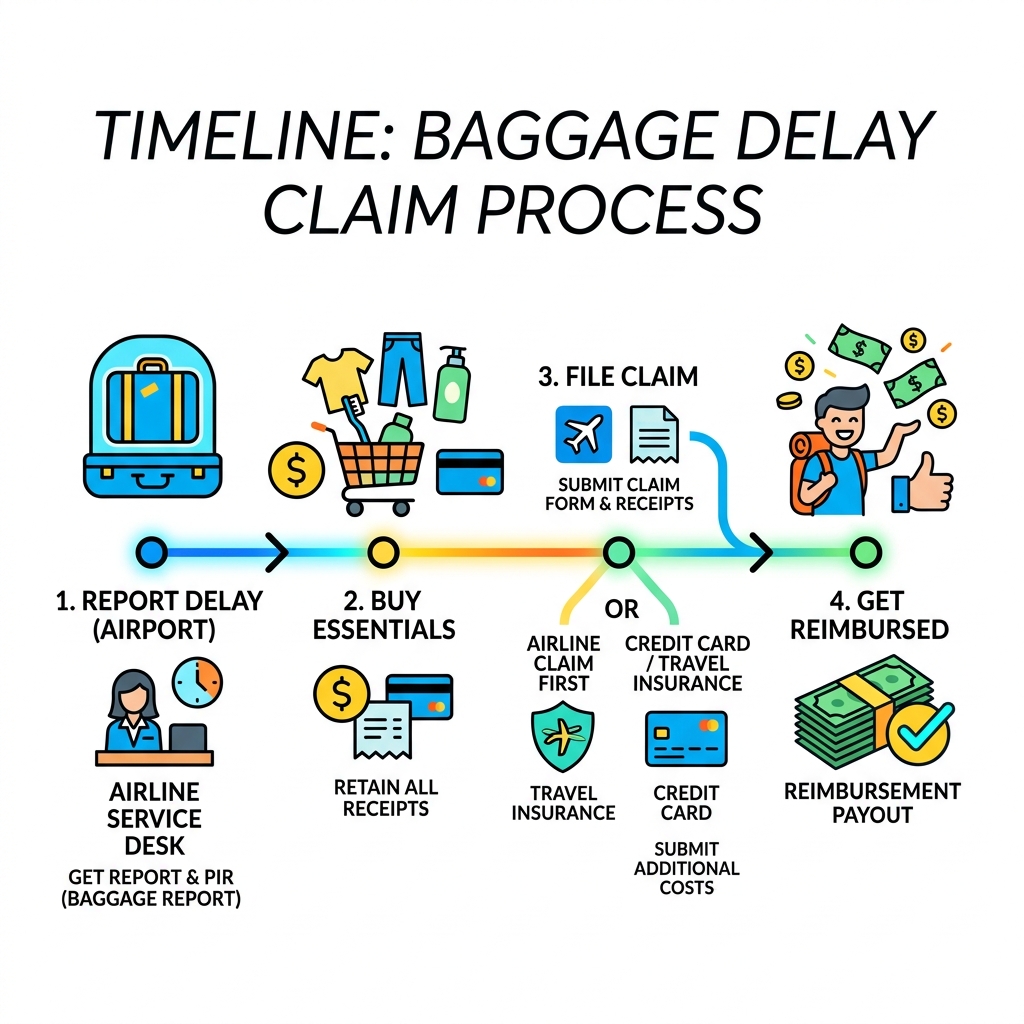
Here’s a quick overview of how it works:
- Report the delay to your airline at the airport as soon as you notice your bag is missing.
- Buy essential items you need while waiting (keep every receipt).
- File a claim with your airline first, then with your credit card or travel insurance provider for any remaining costs.
- Get reimbursed up to the daily and total limits set by your policy or credit card benefit.
Key facts to know upfront:
| Coverage Source | Typical Trigger | Daily Limit | Max Payout |
|---|---|---|---|
| Airline (domestic) | Varies by carrier | No set cap | Up to $4,700 |
| Airline (international) | Varies by carrier | No set cap | ~$2,175 (1,519 SDR) |
| Credit card (e.g., Chase Sapphire Reserve) | 6-hour delay | $100/day | $500 (5 days) |
| Travel insurance (e.g., Allianz) | 12-hour delay | $100/day | Varies by plan |
Imagine landing after a long flight, heading to baggage claim, and watching the carousel spin empty. No bag. It’s frustrating — and it can be expensive if you need to buy clothes or toiletries while you wait.
The good news? You likely have more protection than you think. Most travelers have at least one source of baggage delay coverage they don’t know about — through their airline, their credit card, or a travel insurance policy. The trick is knowing how to use them.
This guide walks you through exactly how to file a claim and get paid.
Understanding Baggage Delay vs. Lost Luggage Coverage
Before we dive into the paperwork, we need to clear up a common point of confusion. There is a massive difference between “delay” and “loss” in travel insurance.
Baggage delay reimbursement is designed to keep you going while your bag is temporarily missing. It covers “reasonable and necessary” items you buy because you don’t have your stuff. Think of it as a bridge to get you through the next 24 to 48 hours. Most policies have a waiting period—a “trigger”—before you can start spending. This is often 6 hours for premium credit cards or 12 hours for standard travel insurance plans.
Lost baggage coverage, on the other hand, kicks in only after the airline officially declares your bag “lost.” This usually happens between 5 and 14 days after your flight. At this point, the claim shifts from buying a temporary toothbrush to being reimbursed for the total value of the suitcase and everything inside it.
If you find yourself at the carousel with no bag, the first thing you should do is Track your bags using the airline’s app or website. Knowing where your bag is (or isn’t) helps you decide if you’re dealing with a short delay or a long-term problem. While you wait, it’s also a great time to research enduring-and-affordable-luggage-for-travellers for your next trip, as higher-quality bags are sometimes easier for airline systems to track and handle.

Key Differences in Payouts
When it comes to baggage delay insurance claims, understanding the hierarchy of coverage is vital. Most insurance policies (both credit card and standalone) are secondary coverage. This means they only pay out after the airline has given you whatever they owe you.
| Feature | Baggage Delay | Lost Baggage |
|---|---|---|
| What it covers | Essentials (toiletries, 1-2 outfits, chargers) | Replacement value of bag and all contents |
| When it starts | 6–12 hours after arrival | 5–14 days after arrival |
| Typical Limit | $100–$200 per day | $2,000–$4,700 total |
| Receipts | Required for all purchases | Required for high-value items |
Airline Liability and Passenger Rights Under DOT Regulations
Many travelers assume that if an airline loses their bag, they are at the mercy of the airline’s “generosity.” That is simply not true. In the United States, the Department of Transportation (DOT) has very strict rules about what airlines must do for you.
According to the Lost, Delayed, or Damaged Baggage | US Department of Transportation guidelines, airlines are required to compensate passengers for “reasonable, verifiable, and actual incidental expenses.”
One of the most important things we want you to remember is that airlines cannot set arbitrary daily limits. If an airline tells you, “We only give $50 a day,” they are likely violating DOT rules. If you are traveling for a wedding and your suit is in the delayed bag, a $50 limit isn’t “reasonable” for a replacement. As long as the expense is necessary and you have the receipt, the airline is generally liable up to their maximum limit.
For domestic flights within the U.S., that liability limit is currently $4,700 per passenger. This is the maximum an airline can be forced to pay for a mishandled bag. To avoid these headaches entirely, many of our readers prefer using top-budget-backpacks-for-long-trips as carry-ons, ensuring their essentials never leave their sight.
International vs. Domestic Flight Rules
If your “detour” happens on an international flight, the rules change slightly. Most international travel is governed by the Montreal Convention.
Under this treaty, the airline’s maximum baggage liability is limited to 1,519 Special Drawing Rights (SDR). Since SDRs are a mix of international currencies, the value fluctuates, but it currently sits at approximately $2,175 USD per passenger.
There are also strict reporting deadlines you must follow:
- For delayed bags: You must file a claim in writing within 21 days of the bag being returned to you.
- For damaged bags: You must report it within 7 days.
- Baggage Fee Refunds: Under newer DOT regulations, if your bag is “significantly delayed” (typically 12 hours for domestic and 15–30 hours for international), you are also entitled to a refund of your checked baggage fees.
Airlines like Air Canada have specific portals for this; you can learn more about their process at Delayed or Damaged Baggage.
Maximizing Your Benefits via Credit Card Issuers
If the airline’s compensation doesn’t cover all your costs, or if they are being difficult, your credit card might be your best friend. Many premium travel cards include baggage delay insurance as a built-in perk.
This coverage is often more straightforward than dealing with an airline. For example, the Chase Sapphire Reserve provides $100 per day for up to five days if your bag is delayed by more than six hours. That’s $500 of “free” shopping for essentials just for being a cardholder.
To be eligible, you generally must have paid for at least a portion of your “common carrier” (airline, bus, train, or cruise) ticket with that specific credit card. If you’re a frequent traveler, we recommend using durable-and-cheap-travel-backpacks-for-long-trips to minimize the chances of needing to check a bag in the first place, but having that card in your wallet provides a great safety net.
Eligibility for Credit Card Baggage Delay Insurance Claims
Who is actually covered? It’s not just the person whose name is on the card. Most baggage delay insurance claims through credit cards cover:
- The primary cardholder.
- The cardholder’s spouse or domestic partner.
- Immediate family members (children under 26).
One catch: the delay must happen while you are traveling on a common carrier. Some cards also exclude the “return leg” of your journey (the flight back home), reasoning that you already have clothes and toiletries at your house. Always check your “Guide to Benefits” for these specific exclusions.
Airlines like American Airlines often provide a Delayed or damaged bags − Travel information − American Airlines portal where you can get the “Proof of Delay” document that your credit card issuer will inevitably ask for.
Step-by-Step Guide to Filing Baggage Delay Insurance Claims
Filing a claim can feel like a part-time job, but if you follow these steps in order, you’ll maximize your chances of a quick payout.
Step 1: File a Report at the Airport Before you leave the airport, go to the airline’s Baggage Service Office. Do not leave without a Property Irregularity Report (PIR) and a File ID number (usually a 13-character code). This is the single most important piece of paper you will receive.
Step 2: Ask for Immediate Relief Sometimes airlines have “amenity kits” with basic toiletries, or they may offer a small amount of immediate cash/vouchers. Take what they offer, but don’t sign anything that waives your right to future claims.
Step 3: Keep Your Receipts Buy what you need, but stay “reasonable.” A $200 toothbrush might get rejected, but a $200 winter coat because you landed in Chicago during a blizzard is perfectly reasonable. Keep every itemized receipt.
Step 4: File with the Airline First Most insurance providers require you to exhaust the airline’s options first. Submit your expenses to the airline within their deadline (usually 21–30 days).
Step 5: File the Supplemental Claim If the airline doesn’t cover everything, use the Trip Insurance Claims Service | Travel Insured or your credit card’s portal to claim the difference. If you used lightweight-luggage-for-affordable-travel, you might even find that your claim is processed faster because the items inside are easier to list and value.
Documentation for Baggage Delay Insurance Claims
To win your claim, you need to be a librarian of your own travel data. You will need:
- The File ID/PIR from the airline.
- Your original boarding pass and baggage claim stubs (the little stickers they put on your ticket).
- Itemized receipts for every single thing you bought.
- A copy of the airline’s final settlement (or their letter denying your claim).
- A Proof of Delay statement from the carrier confirming how long the bag was missing.
Delta, for instance, allows you to share your AirTag location to help speed up the process, which you can read about at Damaged, Delayed or Lost Baggage | Delta Air Lines.
What’s Covered (and What’s Not) in a Typical Claim
What exactly can you buy? The term “essential” is subjective, but most baggage delay insurance claims are approved for the following:
- Toiletries: Toothbrush, toothpaste, deodorant, hairbrush, skincare.
- Clothing: A change of clothes, underwear, socks, and a coat if the weather requires it.
- Chargers: One charger per electronic device is usually covered.
- Special Equipment: Rental of sports equipment or business gear if your bag contained these items.
To keep your suitcase organized and make it easier to itemize your belongings for a claim, we highly recommend using affordable-and-quality-packing-organizers. Not only do they protect your gear, but they also help you remember exactly what was in which bag.
Common Exclusions and Limitations
Don’t assume everything is covered. There are “hard nos” in almost every policy:
- Valuables: Jewelry, watches, and cash are almost never covered under delay or loss. Keep these in your carry-on!
- Electronics: While chargers are okay, most policies won’t pay for a new laptop or camera just because yours is delayed.
- Business Samples: Items meant for resale or professional samples are typically excluded.
- Perishables: If you were checking a suitcase full of Omaha Steaks, the insurance won’t cover them if they spoil.
Frequently Asked Questions about Baggage Delay Insurance Claims
How long does it take to get reimbursed?
Airlines usually process claims within 30 to 60 days. Credit card issuers and third-party insurers are often faster, sometimes paying out within 2 to 4 weeks once all documentation is submitted.
Can I claim for a delay on my return flight home?
This is a “maybe.” Most credit card insurance policies exclude the return trip because the “essentials” you need are already at your house. However, DOT regulations for airlines do not make this distinction; if the airline delays your bag on the way home, they are still liable for your incidental expenses.
What if the airline already gave me a voucher?
You can still file a claim! However, you must disclose the value of the voucher. If your expenses were $200 and the airline gave you a $50 voucher, your insurance will likely only pay the remaining $150.
Conclusion
At FinanceZora, we believe that travel safety isn’t just about where you go—it’s about how you protect yourself along the way. Dealing with baggage delay insurance claims is undeniably a chore, but it’s a chore that can put hundreds of dollars back in your pocket.
The key is to act fast: report the delay immediately, keep every single receipt, and know the difference between your rights under DOT regulations and your perks from your credit card. By staying organized and using the right budget gear, you can turn a travel nightmare into a minor inconvenience.
Ready to level up your travel game? Find more expert travel tips and financial advice on our blog to ensure your next trip is as smooth as possible. Safe travels!
