
Why the Right Travel Insurance Can Save Your Trip (and Your Wallet)
Tips when buying travel insurance can make the difference between a costly disaster and a fully covered setback. Here are the most important ones at a glance:
- Buy early – ideally within 14-21 days of your first trip deposit
- Cover your non-refundable costs – flights, hotels, tours, and cruises
- Check for medical coverage – most U.S. health plans and Medicare don’t cover you abroad
- Read the exclusions – pre-existing conditions, adventure sports, and pandemics may not be covered by default
- Compare standalone policies – don’t rely solely on credit card or booking-site add-on coverage
- Consider Cancel For Any Reason (CFAR) – if your plans are uncertain, it’s worth evaluating
- Match the policy to your trip – a cruise, an international adventure, and a domestic weekend all have different needs
Planning a trip is exciting. But between booking flights, hotels, and activities, most travelers treat insurance as an afterthought — or skip it entirely.
That’s a risky move.
Emergency medical evacuations can cost hundreds of thousands of dollars. A canceled trip with significant prepaid, non-refundable costs can wipe out your travel budget in one blow. And if you’re traveling abroad, your regular U.S. health insurance likely won’t cover a single hospital bill.
The good news? Travel insurance typically costs just 4% to 15% of your total trip cost. For a $5,000 trip, that’s roughly $200-$750 — a small price compared to what you stand to lose.
The challenge isn’t deciding whether to get it. It’s knowing how to buy it smartly — what to look for, what to avoid, and when to pull the trigger.
This guide breaks it all down in plain language.
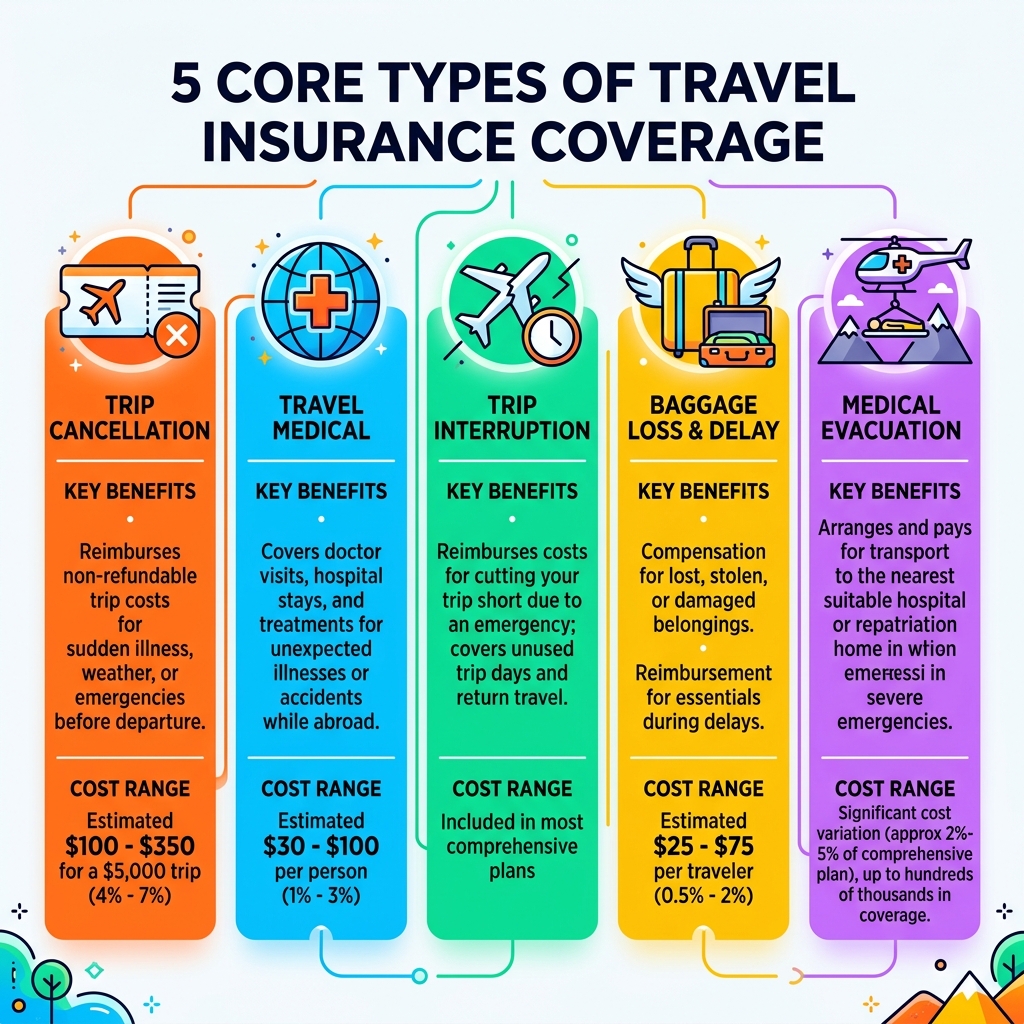
Understanding Coverage: What Your Policy Actually Protects
When we look at a travel insurance policy, it often feels like reading a different language. However, most comprehensive plans are built on five pillars of protection. Understanding these is the first step in mastering tips when buying travel insurance.
- Trip Cancellation: This kicks in before you leave. If you or a family member gets sick, or a natural disaster hits your destination, this reimburses your prepaid, non-refundable expenses.
- Trip Interruption: This is for when the “unthinkable” happens during the trip. If you have to fly home early because of an emergency, it covers the unused portion of your trip and the extra flight costs.
- Travel Delays: If your flight is delayed (usually by 6 hours or more), this covers “catch-up” expenses like meals and a hotel night.
- Baggage Loss and Delay: This helps you replace clothes and toiletries if the airline loses your bag or sends it to the wrong continent.
- Emergency Medical: This is perhaps the most critical part of any policy, covering doctor visits and hospital stays while abroad.
While insurance adds an upfront cost, it is actually one of the most effective ways to reduce travel expenses in the long run by preventing massive out-of-pocket losses.

Essential tips when buying travel insurance for medical emergencies
Medical emergencies are the leading cause of massive travel-related debt. If you are traveling outside the U.S., you must realize that the U.S. government does not pay medical costs for citizens abroad. Even Medicare and Medicaid generally provide zero coverage once you cross the border.
When reviewing the medical section of a policy, keep these “pro” tips in mind:
- Primary vs. Secondary Coverage: We always recommend looking for primary coverage. This means the travel insurer pays your hospital bill first. Secondary coverage requires you to file a claim with your home health insurance first, wait for the inevitable denial, and then ask the travel insurer for the rest. Primary coverage involves much less paperwork and stress during a crisis.
- Medical Evacuation: This isn’t just an ambulance ride. If you are hiking in the Alps or on a cruise in the Caribbean and need a specialized “medevac” jet back to a U.S. hospital, the bill can easily exceed $100,000. Look for policies offering at least $250,000 to $500,000 in evacuation coverage.
- Repatriation of Remains: It’s a somber topic, but if a traveler passes away, the cost of returning their body home is staggering. Good policies include this benefit automatically.
- 24-Hour Helpline: Ensure your provider offers a global, 24/7 assistance line. They don’t just pay the bills; they can help find English-speaking doctors or coordinate with local hospitals.
Navigating exclusions and pre-existing conditions
One of the biggest “gotchas” in the industry involves what is not covered. Most standard policies exclude:
- Pre-existing Medical Conditions: If you have a chronic illness that flared up recently, the insurer might deny the claim. However, you can often get a pre-existing condition waiver if you buy the insurance within 14–21 days of your first trip payment.
- High-Risk Activities: Planning to go skydiving or scuba diving? Standard plans usually exclude “adventure sports.” You may need to buy a specific “adventure rider” to stay protected.
- Foreseeable Events: You can’t buy insurance for a hurricane after the storm has already been named and is heading toward your resort.
- Government Travel Advisories: If the U.S. Department of State issues a Level 4 “Do Not Travel” warning for a country and you go anyway, your policy might be voided.
- Alcohol-Related Incidents: If you get injured while under the influence, don’t expect the insurer to foot the bill. They expect you to follow local laws and exercise reasonable care.
Timing and Cost: When to Pull the Trigger
A common mistake we see is travelers waiting until the week before their trip to buy insurance. By then, you’ve missed the most valuable benefits.
The “Golden Window” for buying travel insurance is within 14 to 21 days of making your initial trip deposit.
Why does this matter? Because many premium benefits—like the pre-existing condition waiver and “Cancel For Any Reason” coverage—are only available if you purchase during this short timeframe. If you miss this window, you can still buy insurance up until the day before you leave, but the coverage will be much more restrictive.
As for the cost, expect to pay between 4% and 15% of your total trip cost. A basic plan for a healthy 30-year-old might be on the lower end, while a comprehensive plan for a 70-year-old traveler will be higher. For those just starting out, check our budget travel tips for beginners to see how to balance these costs with your overall savings goals.
Single-Trip vs. Annual Multi-Trip Policies
| Feature | Single-Trip Policy | Annual Multi-Trip Policy |
|---|---|---|
| Best For | One big, expensive vacation | 3+ trips per year |
| Cost | Based on specific trip price | Flat annual fee (often ~$300+) |
| Medical Limit | Usually very high | Can be lower per trip |
| Cancellation | Covers full trip cost | Often has a lower annual cap |
Maximizing benefits with early purchase tips when buying travel insurance
Buying early doesn’t just check a box; it unlocks “Financial Default Protection.” This protects you if the airline or tour operator goes bankrupt. Usually, this coverage only kicks in if the policy was purchased at least 10–14 days before the company fails.
If you are worried about the complexities of planning, our budget travel tips for beginners-2 guide can help you organize your booking timeline so you never miss these critical insurance deadlines.
Comparing Your Options: Standalone vs. Existing Protection
Before you spend hundreds on a standalone policy, we recommend auditing the protection you already have. However, be wary: existing protection often has massive gaps.
- Credit Card Benefits: Premium cards (like the Chase Sapphire Reserve) offer decent trip cancellation and baggage protection. But they often have low limits (e.g., $10,000 max) and rarely provide significant emergency medical coverage. To use this, you must book the entire trip on that specific card.
- Homeowners/Renters Insurance: Your home policy might actually cover your laptop or jewelry if they are stolen while you’re abroad. Check your “off-premises” coverage limits.
- Health Insurance: As mentioned, U.S. health plans usually fail abroad. Even if your plan offers “emergency” international coverage, it will likely be out-of-network, requiring you to pay thousands upfront and fight for reimbursement later.
For those looking to save, using stay-safe-with-budget-travel-safety-gear can reduce the risk of theft, which might allow you to opt for a policy with a higher baggage deductible.
Is ‘Cancel For Any Reason’ (CFAR) worth the extra cost?
CFAR is the “Gold Standard” of flexibility. Standard trip cancellation only covers specific reasons (illness, death, etc.). CFAR allows you to cancel because you changed your mind, or you’re simply worried about safety.
The Reality Check of CFAR:
- Cost: It typically adds 40% to 50% to your premium price.
- Reimbursement: You don’t get 100% back. Most CFAR plans only reimburse 50% to 75% of your non-refundable costs.
- Rules: You must buy it within the 14–21 day window and cancel at least 48 hours before departure.
Is it worth it? If you are traveling to a region with political instability or you have a high-stress job that might require you to cancel at the last minute, it’s a smart move. Otherwise, standard cancellation is usually enough. You can find more ways to reduce travel expenses-2 by skipping these high-cost add-ons when they aren’t strictly necessary.
Expert tips when buying travel insurance for your specific trip
Every trip has a different “risk profile.” We recommend tailoring your policy to your itinerary:
- Cruises: Cruises are notorious for “missed connections.” If your flight is delayed and the ship sails without you, you need a policy that covers the cost of flying you to the next port. Also, shipboard medical care is extremely expensive.
- International Adventures: If you’re heading to remote mountains, medical evacuation is your #1 priority. Make sure your policy doesn’t exclude the altitude you’ll be at!
- Domestic Road Trips: You probably don’t need medical coverage (your home plan works here), but you might want “Rental Car Damage” coverage, which is often cheaper through a travel insurer than the rental desk.
When traveling light to save money, as we suggest in our guide on how to travel light and save money, you might find you need less baggage coverage, allowing you to focus your budget on higher medical limits.
Frequently Asked Questions about Travel Insurance
Does travel insurance cover pandemics like COVID-19?
Post-2020, most major insurers have updated their policies. Many now treat COVID-19 like any other unexpected illness. If you test positive before your trip and can’t go, or if you get sick during the trip and need a hospital, you’re usually covered.
However, “fear of travel” due to a pandemic is not a covered reason under standard plans. For that, you would need CFAR. Some policies also offer “Quarantine Lodging” benefits if you are forced to isolate in a hotel abroad. Always check the fine print for the words “epidemic” or “pandemic.”
How do I file a successful travel insurance claim?
The biggest reason claims get denied is a lack of documentation. We recommend being a “paperwork pro”:
- Proof of Ownership: Take photos of your packed bags and keep digital receipts for expensive items.
- Doctor’s Notes: If you cancel for medical reasons, you must have a signed statement from a doctor saying you were medically unfit to travel at the time of cancellation.
- Receipt Tracking: Save every meal and hotel receipt if your trip is delayed.
- Proof of Loss: If your bag is stolen, you must file a police report within 24 hours. Without that official report, the insurer will likely deny the claim.
Learning how to travel light and save money-2 can actually help here—fewer items mean less paperwork if something goes missing!
Is travel insurance a waste of money for domestic trips?
Not necessarily. While your health insurance likely follows you across state lines, it won’t reimburse you for a non-refundable $2,000 boutique hotel stay if you break your leg the day before check-in. If your domestic trip involves significant non-refundable prepayments (like a Disney package or a luxury lodge), insurance is still a wise investment.
Conclusion
At FinanceZora, we believe that smart financial planning doesn’t stop once you book your flight. It continues with protecting that investment. Buying travel insurance isn’t about being pessimistic; it’s about being prepared so that one bad break doesn’t ruin your financial health.
By following these tips when buying travel insurance, you can navigate the fine print with confidence. Remember to buy early, focus on primary medical coverage, and always document your belongings before you leave.
Ready to dive deeper into making your next adventure both safe and affordable? Learn more about travel tips on our dedicated hub. Safe travels!
