
When Your Bag Doesn’t Show Up: What You Need to Know About Lost Luggage Insurance Claims
Lost luggage insurance claims are the formal process of seeking reimbursement for bags that airlines lose, damage, or delay — going beyond what the airline itself will pay you.
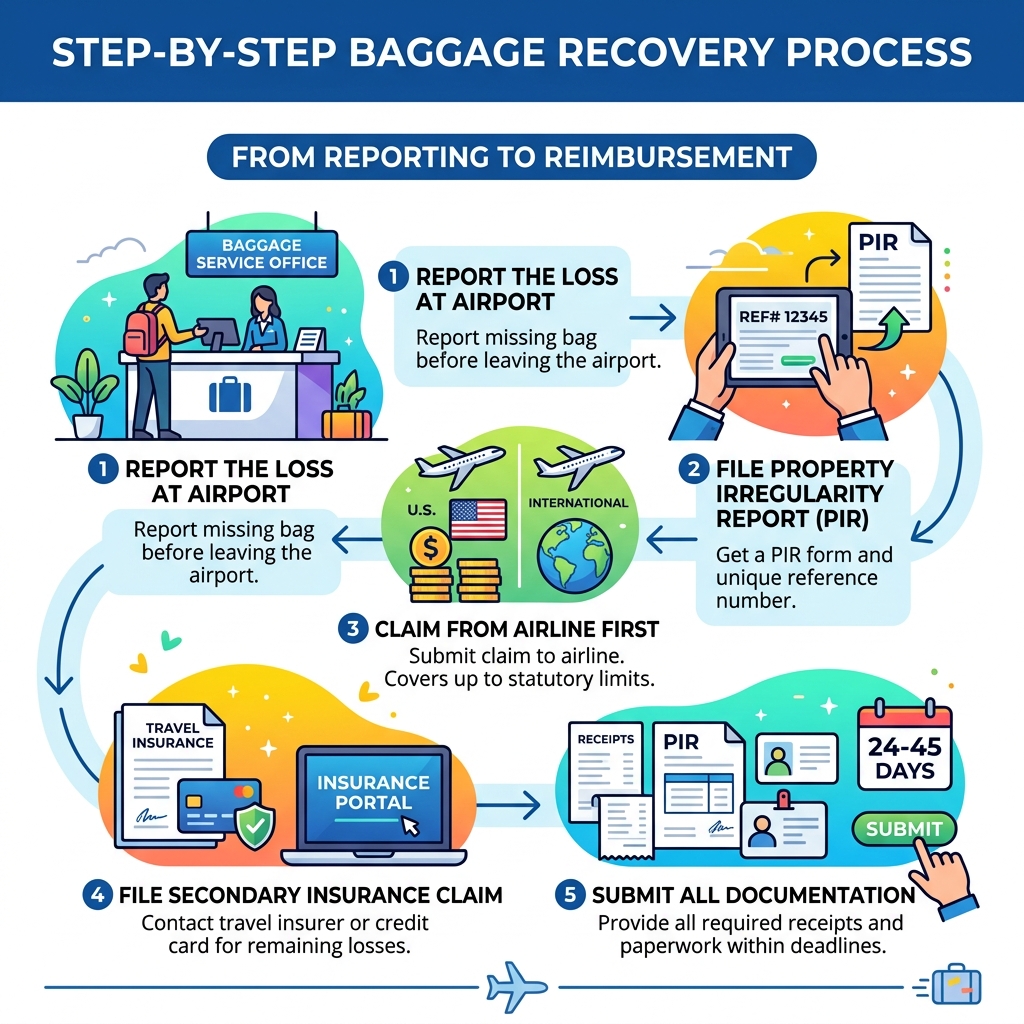
Here’s the quick version of how it works:
- Report the problem at the airport’s Baggage Service Office before you leave.
- File a Property Irregularity Report (PIR) and get a reference number.
- Claim from the airline first — U.S. domestic flights cover up to $3,800; international flights up to ~$2,175.
- Then file with your travel insurer or credit card for any remaining losses (coverage is typically secondary, meaning it pays after the airline).
- Submit all receipts and documentation within the required deadlines (often 24–45 days depending on the insurer).
Every traveler’s nightmare: you’re standing at baggage claim, watching the carousel spin, and your bag never comes. It’s stressful, disorienting, and can throw your whole trip off balance — especially if you’re on a budget.
The good news? You likely have more protection than you think. Airlines are legally required to compensate you for lost bags. And if that doesn’t cover everything, your credit card or travel insurance policy may pick up the rest.
The bad news? The process isn’t always obvious. Deadlines are tight. Documentation matters. And each layer of coverage — airline, credit card, travel insurer — has its own rules.
This guide walks you through exactly what to do, step by step, so you don’t leave money on the table.
Understanding Your Rights: Airline Liability vs. Lost Luggage Insurance Claims
When we talk about getting paid for a missing suitcase, we are usually looking at two different pots of money. The first is airline liability, and the second is lost luggage insurance claims through a third party.
DOT Regulations and International Treaties
In the United States, the Department of Transportation (DOT) sets the rules for domestic flights. Currently, airlines are liable for up to $3,800 per passenger for lost, damaged, or delayed baggage. If you are flying internationally, the rules change based on global treaties. The Montreal Convention covers most international routes and sets the limit at approximately $2,175 (1,288 Special Drawing Rights). Older routes might still fall under the Warsaw Convention, which pays significantly less—often based on the weight of the bag (about $9.07 per pound).
Secondary Coverage and the “Excess Basis”
This is where many travelers get confused. Most travel insurance policies and credit card benefits operate on an “excess” or secondary basis. This means they only pay out after the airline has given you their maximum. If the airline pays you $1,500 for a bag worth $2,500, your insurance claim would aim to cover that $1,000 gap. You cannot “double dip” and get the full value from both sources. For more details on these legal protections, you can review the Official DOT baggage guidance.
Immediate Action Plan: What to Do at the Baggage Carousel
The moment you realize your bag isn’t coming, the clock starts ticking. Do not leave the airport without a paper trail!
- Find the Baggage Service Office (BSO): Every airline has a desk near the carousels. Even if there is a long line of frustrated people, wait your turn.
- File a Property Irregularity Report (PIR): This is the most critical document for lost luggage insurance claims. The PIR contains your contact info, bag description, and a unique 10-to-13-character file reference number.
- Note the Deadlines: For domestic flights, most airlines require you to report a delay or damage within 24 hours. For international flights, you might have up to 7 days for damage and 21 days for delays, but reporting it immediately is always safer.
- Ask About Essentials: If you are away from home, ask the agent if they provide “amenity kits” or immediate cash/vouchers for toiletries.

If you happen to be flying with a carrier that offers digital tools, use them! For example, you can Track your bags with United directly through their app to see if your suitcase simply missed a connection.
Filing Your Claim: A Step-by-Step Guide
Once you have your PIR in hand, the real work begins. You’ll need to be organized to ensure your lost luggage insurance claims aren’t denied on a technicality.
Eligibility for Lost Luggage Insurance Claims via Premium Cards
Many of us carry “hidden” insurance in our wallets. If you paid for your flight (even just the taxes on an award flight) with a premium travel card, you likely have coverage.
- Chase Sapphire Preferred® & Reserve®: These offer up to $3,000 per person for lost or damaged luggage. They also include baggage delay insurance of $100 per day (up to 5 days) if your bag is late by more than 6 hours.
- American Express Platinum Card®: Provides up to $3,000 for combined carry-on and checked bags, with a $1,000 limit for “high-risk” items like jewelry.
- Bank of America Executive Explorer: Offers reimbursement up to $5,000, though residents of New York may see a $2,000 per bag limit.
To keep your gear safe in the first place, we often recommend investing in durable travel backpacks that you can keep with you in the cabin.
Documentation Needed for Successful Lost Luggage Insurance Claims
Insurers love paperwork. To get your check, you will generally need:
- A copy of the PIR from the airline.
- Your original flight itinerary showing you paid with the eligible card.
- Itemized receipts for everything inside the bag (if you don’t have these, some insurers accept photos or bank statements, but they may depreciate the value).
- A settlement letter from the airline showing how much they already paid you.
- For stolen items, a police report filed within 24 hours of the discovery.
If you believe your items went missing during security, check the TSA claim instructions to file a separate report with the government.
Coverage Limits, Timelines, and Exclusions
Not everything in your suitcase is covered. Understanding the “fine print” prevents heartbreak later.
Liability Limits Table
| Flight Type | Governing Rule | Max Liability (Approx) |
|---|---|---|
| U.S. Domestic | DOT Regulation | $3,800 per passenger |
| International | Montreal Convention | $2,175 (1,288 SDR) |
| International (Old) | Warsaw Convention | $9.07 per pound |
The “Lost” Window
Airlines don’t consider a bag “lost” the moment it doesn’t show up. Usually, a bag is “delayed” for the first 5 to 14 days. After that window, the airline officially declares it lost, and you can begin the full reimbursement process.
Common Exclusions
Most lost luggage insurance claims will not cover:
- Cash and Negotiable Instruments: Never pack money or checks in checked bags.
- High-Value Electronics: Laptops, cameras, and tablets are often excluded by airlines (though some premium credit cards offer limited coverage).
- Perishables and Fragile Items: If your glass souvenir breaks or your cheese spoils, you’re likely out of luck.
- Animals: Insurance rarely covers pets traveling in the hold.
If you’re worried about the bag itself getting beat up, check out our guide on enduring and affordable luggage for travellers to find gear that can handle the rough-and-tumble of airport belts.
Maximizing Your Reimbursement for Delayed Bags
If your bag is just late (delayed), you don’t have to wear the same clothes for four days. Airlines are required to reimburse you for “reasonable and necessary” expenses.
- The $50/Day Myth: Many airline agents will tell you there is a $50 per day limit. This is false. The DOT prohibits airlines from setting arbitrary daily limits. If you are attending a wedding and your suit is in the missing bag, a $200 rental is “reasonable.”
- Keep Your Receipts: You won’t get a dime without itemized, dated receipts.
- The 12-Hour Threshold: For many credit card benefits, baggage delay coverage kicks in after your bag has been missing for 6 to 12 hours.
- Essential Items Only: Don’t go on a shopping spree for designer handbags. Stick to toiletries, undergarments, and basic clothing.
Using lightweight luggage for travel can sometimes help you avoid checking a bag altogether, which is the only 100% way to prevent a delay!
Frequently Asked Questions about Baggage Claims
When is a bag officially considered “lost” by airlines?
It varies by carrier. United Airlines typically considers a bag lost if they cannot find it within 5 days. Delta Air Lines and British Airways usually wait until 21 days have passed before moving from “delayed” to “lost” status. Once that 21-day mark hits, you should immediately finalize your claim. You can find more specifics on the British Airways claim info page.
Does homeowners or renters insurance cover lost luggage?
Surprisingly, yes! Most homeowners and renters policies include “off-premises” coverage for personal property. This means if your suitcase is stolen from a hotel room or lost by a carrier, your home insurance might help.
- The Catch: You’ll have to pay your deductible first (which is often $500 or $1,000).
- The Strategy: Only use this for very high-value losses that exceed airline and credit card limits.
What should I do if my bag is damaged during a TSA inspection?
If you open your bag and find a “Notice of Baggage Inspection” inside along with broken items, the airline might not be responsible. You must file a claim directly with the TSA. You can call their claims office at 866-289-9673. If the damage was clearly caused by the airline’s machinery (like a ripped handle or crushed shell), follow the American Airlines damage reporting steps or the equivalent for your carrier.
Conclusion
At FinanceZora, we know that travel is an investment of both your time and your hard-earned money. Dealing with lost luggage insurance claims is never fun, but being persistent pays off. Remember to keep every receipt, take photos of your bag’s contents before you fly, and never leave the airport without that PIR reference number.
By understanding the layers of protection provided by the DOT, your credit card, and your insurance provider, you can turn a travel disaster into a manageable bump in the road. Stay safe, stay organized, and keep exploring! For more ways to protect your wallet while seeing the world, visit our expert travel tips and advice section.
