
The Best Cheap Travel Cameras for Your Next Adventure
Looking for a cheap travel camera that won’t let you down on the road? Here are the top picks worth knowing about right away:
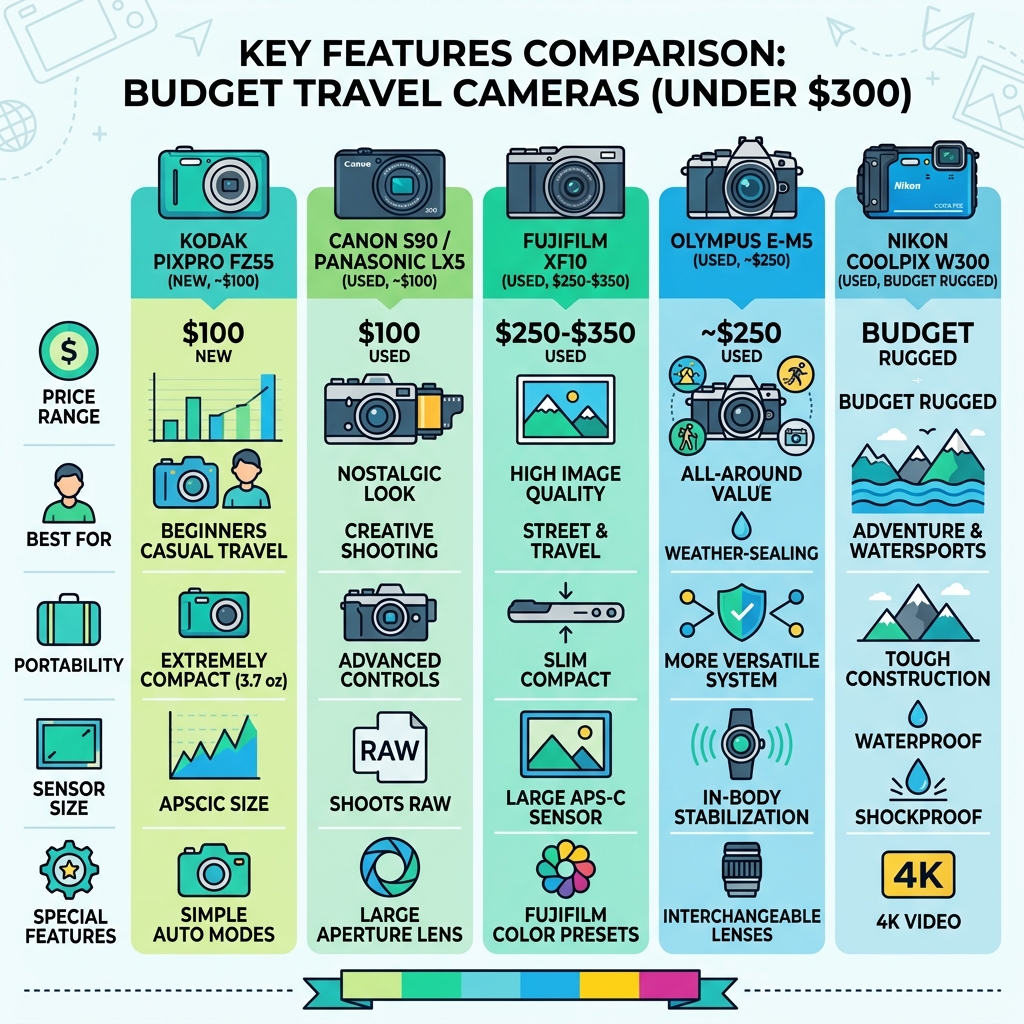
| Camera | Price Range | Best For |
|---|---|---|
| Kodak PIXPRO FZ55 | ~$100 new | Beginners, casual travel |
| Canon S90 / Panasonic LX5 | ~$100 used | Nostalgic look, RAW shooting |
| Fujifilm XF10 | $250-$350 used | Image quality, APS-C sensor |
| Olympus E-M5 | ~$250 used | Weather-sealing, all-around value |
| Nikon COOLPIX W300 | Budget rugged | Adventure, waterproof travel |
Most travelers assume their smartphone is good enough. Sometimes it is. But a dedicated travel camera gives you real optical zoom, better low-light shots, and longer battery life — without costing a fortune.
The market is crowded with options across every price range. A brand-new point-and-shoot like the Kodak PIXPRO FZ55 starts at just $99.99. Used vintage digicams like the Canon S90 can be found for around $100. And if you stretch to $250-$350, you can land something with a sensor 10-15x larger than your phone’s.
The tricky part isn’t finding a cheap camera — it’s finding the right one for how you actually travel.
This guide breaks down the best options by budget, use case, and what you actually get for your money.
What Makes a Camera Ideal for Budget Travel?
When we talk about a cheap travel camera, we aren’t just looking at the price tag. A “deal” isn’t a deal if the camera is too heavy to carry or breaks the first time it sees a grain of sand. For us at FinanceZora, the ideal travel companion needs to balance four specific pillars: size, weight, durability, and ease of use.
First, let’s talk about portability. If a camera doesn’t fit in your jacket pocket or a small sling bag, you’re going to leave it in the hotel room. The best budget options weigh mere ounces. For instance, the Kodak PIXPRO FZ55 weighs only 3.7 oz—that is lighter than most smartphones!
Durability is the next big factor. Travel is messy. You’re dealing with humidity in Bali, dust in the Grand Canyon, or the occasional spilled espresso in a Parisian cafe. While ultra-budget cameras are rarely “invincible,” choosing a model with a reputation for solid build quality—or opting for a dedicated rugged camera—saves you money in the long run by avoiding replacements.
Finally, we look for optical zoom. This is the “secret sauce” that smartphones often struggle with. A real lens that moves physically allows you to capture architectural details on a cathedral or a distant animal on a hike without the “digital mush” you get when pinching-to-zoom on a phone screen.
If you are just starting out, check out our guide on budget-friendly cameras for travel photography beginners to see how to align your gear with your skill level.

Top Picks for a Cheap Travel Camera Under $300
Finding a high-performing cheap travel camera under the $300 mark is surprisingly easy if you know where to look. While the “new” market is dominated by a few brands like Kodak, the “used” market opens up professional-grade features for a fraction of their original cost.
| Feature | Kodak PIXPRO FZ55 | Nikon COOLPIX W300 | Olympus E-M5 (Used) |
|---|---|---|---|
| Price | ~$99.99 | ~$250-$300 (Refurb) | ~$250 |
| Sensor | 16MP CMOS | 16MP CMOS | 16MP Live MOS |
| Zoom | 5x Optical | 5x Optical | Lens Dependent |
| Specialty | Ultra-lightweight | Waterproof/Rugged | Weather-sealed/EVF |
The Kodak PIXPRO FZ55 Digital Camera (Blue) is currently one of the best “bang-for-your-buck” brand-new options. For under $100, you get a 16MP sensor, 1080p Full HD video, and a 5x optical zoom lens that covers a 28-140mm equivalent range. It’s the perfect “friendly zoom” for those who want a dedicated device without the complexity of manual settings.
On the other hand, if you are willing to buy used, the Olympus E-M5 is a legendary choice. Available for around $250 (roughly 200 quid), it offers features usually reserved for expensive gear: weather-sealing, an electronic viewfinder (EVF), in-body image stabilization (IBIS), and a tilting screen. It’s a “pro” experience on a backpacker’s budget.
Rugged Options for Adventure Seekers
If your “adventure” involves more than just walking tours, you need something that can survive a dunk in the ocean or a drop on the pavement. The Nikon COOLPIX W300 Orange is the gold standard for budget-conscious thrill-seekers.
This isn’t just a camera; it’s a survival tool. It is waterproof down to 30 meters (100 feet), shockproof, freezeproof, and dustproof. Beyond the 16MP low-light sensor and 4K UHD video, it features a built-in GPS, eCompass, altimeter, and depth gauge. Whether you are SCUBA diving or skiing, the W300 tracks your location and altitude while capturing the action. It even has a dedicated “Tool” button to check your compass or depth even when the camera is off.
Best Value Vintage Digicams
There is a massive trend right now toward “vintage” digicams from the late 2000s. Why? Because they offer a “film-like” look that modern, ultra-sharp smartphone AI tries to erase.
Cameras like the Canon PowerShot S90 and the Panasonic Lumix LX5 are absolute steals on the used market, often found for around $100. These cameras were “prosumer” models back in the day, meaning they have:
- CCD Sensors: Many enthusiasts prefer these older sensors for their unique color science and nostalgic aesthetic.
- RAW Capabilities: Unlike basic point-and-shoots, these let you save “unprocessed” files for better editing later.
- Fast Lenses: With apertures like f/2.0, they perform better in low light than your average budget camera.
These are tiny, pocketable powerhouses that make photography feel like a hobby again rather than just another tap on a screen.
Digicams vs. Smartphones: The Battle for Image Quality
We get this question all the time: “Why should I buy a cheap travel camera when my iPhone is right here?”
It comes down to the physics of light. While smartphone software is incredible, it can’t beat a larger physical sensor. Take the Fujifilm XF10, for example. You can often find this used for $250-$350. It features an APS-C sensor, which is roughly 10 to 15 times larger than the sensor in a standard smartphone.
A larger sensor means:
- Natural Bokeh: You get that beautiful, blurry background in portraits without the “fake” look of software-driven Portrait Modes.
- Low-Light Performance: Larger pixels soak up more light, meaning less “grain” or “noise” in your night shots of Tokyo or London.
- Dynamic Range: You can see details in both the bright clouds and the dark shadows of a landscape, something phones often struggle to balance.
For more on why these dedicated devices outshine mobile photography, read our deep dive into top affordable travel cameras with high quality.
Why a Cheap Travel Camera Beats Your Smartphone
Beyond just the sensor, there are practical reasons to carry a dedicated camera:
- Optical Zoom: As mentioned, a 5x or 10x optical zoom lets you get close to the action without losing resolution.
- Battery Life: Using your phone as a camera, GPS, and translator all day is a recipe for a dead battery by noon. A camera like the Kodak PIXPRO FZ45 uses AA batteries, which you can buy at any corner store in the world.
- Tactile Controls: There is a joy in pressing a physical shutter button and turning a dial. It makes you more intentional about the photos you take.
- Film Simulations: Cameras like the Fujifilm XF10 have built-in modes (like Classic Chrome) that give your photos a professional, edited look straight out of the camera, ready for Instagram via Wi-Fi transfer.
Smart Shopping: Where to Buy Used and Vintage Gear
To get the best cheap travel camera, you usually have to look at the “pre-loved” market. We recommend sites like MPB, KEH, and Adorama for used gear because they inspect every item and often provide a short warranty. While eBay can be cheaper, it requires more vigilance.
When shopping for used cameras, keep this checklist in mind:
- Shutter Count: For mirrorless or DSLR cameras, ask for the shutter count. It’s like the mileage on a car.
- Glass Inspection: Look closely at photos of the lens. You want to avoid any scratches, “fungus” (spider-web-like patterns inside the glass), or excessive dust.
- Sensor Condition: If it’s an interchangeable lens camera, ensure the sensor is clean and free of scratches.
- Battery Availability: Before buying a 15-year-old camera, make sure you can still buy replacement batteries online!
How to Maintain Your Cheap Travel Camera on the Road
Once you’ve found your perfect cheap travel camera, you need to keep it running. Here are our top “pro” tips for budget travelers:
- X-Ray Safety: While digital cameras are generally safe, new airport CT scanners are much more powerful than old X-ray machines. While they won’t “wipe” your SD card, they can theoretically affect very sensitive electronics over time. More importantly, if you are carrying film as a backup, always ask for a hand-check, as these new scanners will fog your film instantly.
- Power Management: If your camera uses a proprietary Li-ion battery, always carry a spare. If it uses AAs (like the Kodak FZ45), invest in high-quality lithium or rechargeable NiMH batteries; standard alkaline batteries often die after just 20-30 shots in digital cameras.
- Storage: Use high-quality SDXC cards (Class 10 or higher). A card like the KODAK PIXPRO Friendly Zoom FZ45-BL supports up to 512GB, which is enough for thousands of photos and hours of video.
- Protection: You don’t need an expensive bag. A simple padded wrap or a small neoprene sleeve inside your regular backpack is often enough to keep your camera safe from scratches.
Frequently Asked Questions About Budget Travel Photography
Is image quality from cheap cameras sufficient for social media?
Absolutely. In fact, for platforms like Instagram, the 16MP to 20MP provided by most budget cameras is more than enough. The “character” of older digicams often performs better on social media because the photos look unique compared to the standard “smartphone look” everyone else is posting.
How do I avoid X-ray damage when traveling with cameras?
For digital cameras, you don’t need to worry much—just put them through the scanner. However, if you are a “film girlie” or hobbyist using analog backups, be aware that new airport CT scanners (the ones where you don’t have to take liquids out) are much stronger. Always ask for a manual hand-check for your film to avoid “fogging” your memories.
Which budget cameras provide the best ‘film-like’ look?
Look for cameras with CCD sensors (mostly made before 2010). The Canon S90, Nikon Coolpix L series, and older Sony Cyber-shots are famous for this. Additionally, Fujifilm cameras like the XF10 have built-in “Film Simulations” that mimic classic film stocks like Provia and Velvia.
Conclusion
At FinanceZora, we believe that world-class memories shouldn’t require a world-class credit limit. Finding a cheap travel camera is about more than just saving money—it’s about finding a tool that makes you excited to see the world.
Whether you choose the rugged reliability of a Nikon W300, the brand-new simplicity of a Kodak FZ55, or the nostalgic charm of a used Canon S90, you are making an investment in your travel experience. These cameras allow you to put your phone away, save your mobile battery for emergencies, and focus on the art of the journey.
Ready to gear up for your next trip? Explore more travel gear guides for practical advice on everything from luggage to safety tech. Happy shooting!
