
You Don’t Have to Spend a Lot to Stay Safe While Traveling
The best affordable safety gear travel picks — all under $50 — that every traveler should consider:
| Safety Item | What It Does | Typical Price |
|---|---|---|
| Personal alarm | Emits loud siren to deter attackers | $8–$20 |
| Rubber door wedge/alarm | Blocks and alerts if door is opened | $10–$25 |
| RFID-blocking wallet | Stops digital card skimming | $10–$30 |
| Retractable cable lock | Secures luggage to fixed objects | $10–$20 |
| Apple AirTag | Tracks bags in real time | ~$29 |
| Reflective tape | Improves visibility at night | $7–$10 |
| Portable charger | Keeps phone powered for emergencies | $20–$40 |
| Mini first aid kit | Handles cuts, blisters, minor wounds | $15–$35 |
| Dummy wallet | Gives thieves a decoy | $0–$5 |
| VPN app | Encrypts data on public Wi-Fi | Free–$10/mo |
Travel is more popular than ever in 2025 — and so is solo travel. But it comes with real risks. A poll of frequent travelers found that 38% had been a victim of crime while traveling. Pickpockets, digital skimmers, unsafe hotel rooms, and lost luggage are not rare edge cases. They happen to experienced travelers too.
The good news? You don’t need an expensive kit to protect yourself.
Most of the gear by seasoned, high-mileage travelers swear by costs less than a restaurant meal. A door wedge that costs under $10 can secure a hotel room better than a flimsy lock. A $7 pack of reflective tape can make you visible to traffic on a dark street. A $29 tracker can reunite you with lost luggage in minutes.
This guide cuts through the noise. Whether you’re a first-time solo traveler or a road-worn veteran, you’ll find practical, tested, budget-friendly options that cover every layer of travel security — from physical theft to digital privacy to health emergencies.
Essential Affordable Safety Gear Travel Items Under $50
When we talk about affordable safety gear travel, we aren’t just looking for the cheapest items on the shelf; we’re looking for high-value tools that actually work. Our team has logged over 200,000 miles testing gear, and we’ve found that the most effective protection often comes in small, inexpensive packages.
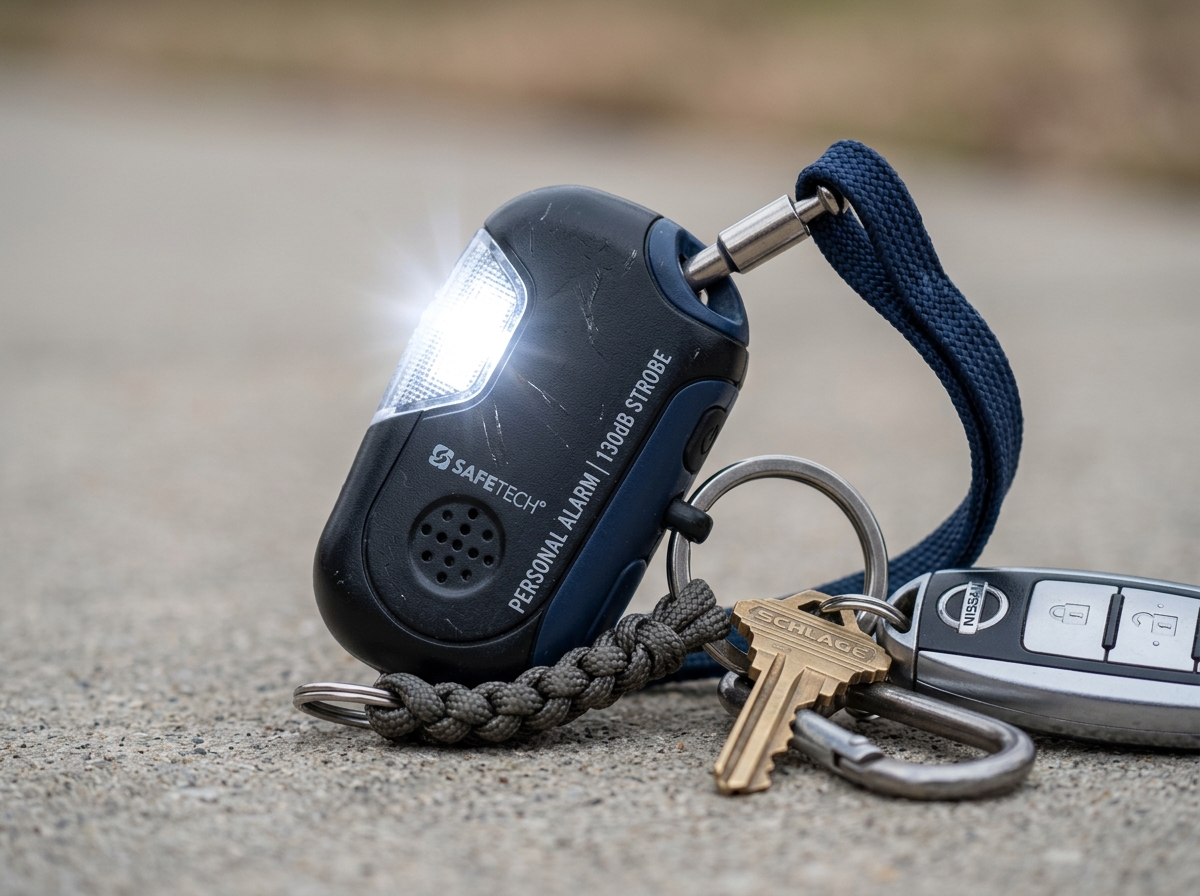
Personal alarms are a top recommendation for anyone, especially solo travelers. Devices like the Birdie or similar keychain alarms are legal in places where pepper spray is not. When you pull the pin, they emit a piercing 130dB siren and a strobe light. It’s designed to startle a predator and draw immediate attention. Pro tip: if you’re packing one in your checked bag, consider removing the battery so it doesn’t accidentally go off mid-flight and cause a security scare!
Safety whistles are another low-tech, high-impact item. A high-decibel whistle can be heard much further than a human voice. In the hiking world, three sharp blasts is the universal signal for distress. Whether you’re on a trail in Vermont or walking a quiet street in Lima, a whistle is a lightweight “must-have.”
For those walking at night, visibility is a major safety factor often overlooked. Reflective tape is an absolute bargain—you can get a pack of 40 pieces for around $7. Stick small strips on your shoes, your backpack, or your jacket. It makes you visible to traffic in low-light areas where sidewalks might be non-existent.
Lastly, never underestimate the power of a “dummy wallet.” This is simply an old wallet filled with a few expired credit cards and a small amount of local currency (equivalent to $5–$10). If you are ever confronted by a mugger, you hand over the dummy wallet and keep your actual cards and passport hidden in a more secure location. It’s a $0 security layer that can save your entire trip. For more on how to integrate these into your routine, check out our guide on how to stay-safe-with-budget-travel-safety-gear.
Securing Your Sleep with Affordable Safety Gear Travel Tools
Your accommodation should be your sanctuary, but unfortunately, hotel and Airbnb security can be hit or miss. Many European hotels lack deadbolts, and in short-term rentals, you never truly know how many previous guests still have a copy of the key.
A simple rubber door wedge is perhaps the best “bang for your buck” safety item. Shoved firmly under the door from the inside, it makes it nearly impossible for someone to push the door open, even if they have a key. For an upgrade, you can buy a door stop alarm. These function like a regular wedge but feature a metal sensor; if the door touches it, a loud alarm sounds, waking you up and likely scaring off the intruder.
If you want a more robust solution, portable door locks (often called “addalocks”) insert into the door strike plate and prevent the door from being opened from the outside. These are great for rooms that only have a basic handle lock.
For a comprehensive approach, the Brickgear Essential Travel Safety Kit TSK is a curated collection designed to manage these exact risks. It includes items like a burglary alarm and a door wedge, ensuring you aren’t just relying on the hotel’s hardware. Remember to test your batteries before you leave; a safety device with a dead battery is just extra weight in your carry-on.
Maximizing Affordable Safety Gear Travel with Smart Tech
Digital safety is just as important as physical safety in 2025. One of the biggest game-changers in recent years has been the Apple AirTag. For about $29, you can track your luggage in real-time. Whether the airline loses your bag or someone walks off with it at a train station, you’ll know exactly where it is. We’ve seen countless stories of travelers finding their “lost” bags in secondary warehouses because their AirTag showed the location more accurately than the airline’s tracking system.
Beyond physical tracking, you need to protect your data. A VPN (Virtual Private Network) is essential for anyone using public Wi-Fi at airports or cafes. It encrypts your connection, making your online activity anonymous. While some VPNs can slow your connection down, the privacy trade-off is worth it. Pair this with a reputable password manager so you aren’t carrying around a physical list of logins or using the same weak password for everything.
In terms of hardware, a portable charger is arguably your most important safety tool. A dead phone means no GPS, no way to call an Uber, and no way to contact emergency services. Look for one with at least 10,000mAh capacity to ensure you can get at least two full charges for your smartphone.
If you are looking for a way to carry all this tech securely, the Pacsafe® EXP35 anti-theft travel backpack is a stellar investment. While it might be at the higher end of a “budget” list, its features like self-locking zippers and a lockable laptop compartment provide professional-grade security for your expensive electronics.
Anti-Theft Bags and Discreet Protection for Solo Travelers
Pickpockets are masters of distraction, often working in teams in crowded areas like Barcelona’s Las Ramblas or the Paris Metro. To beat them, you need gear that makes their job too difficult to be worth the effort.
Anti-theft bags are designed with three main layers of protection:
- Slash-resistant materials: These bags often have a lightweight wire mesh (like eXomesh) embedded in the fabric and stainless steel wires in the straps to prevent “cut and run” thefts.
- Locking zippers: Instead of simple pull tabs, these zippers clip into a security hook, making it impossible for a pickpocket to unzip your bag while you’re standing in a crowd.
- RFID-blocking pockets: These prevent “digital pickpocketing,” where thieves use scanners to skim your credit card info through the fabric of your bag.
The Pacsafe® GO Anti-Theft Tech Crossbody is a perfect example of a sleek, affordable bag that fits these criteria. It’s small enough to be discreet but tough enough to stop a blade.
For even more discreet protection, consider an infinity scarf with a hidden zipper pocket. It looks like a normal accessory, but it can hold your passport and emergency cash right under your nose. Money belts are another classic option, though we recommend wearing them only on travel days (moving between cities) rather than as a daily purse.
If you don’t want to buy a whole new bag, you can “upgrade” your current one with zipper clips or a phone lanyard. A phone lanyard attaches your device to your wrist or bag strap, preventing someone from snatching it out of your hand while you’re looking at a map—a very common tactic in many major cities.
Health and Emergency Preparedness on a Budget
Safety isn’t just about crime; it’s about being prepared for the unexpected “oops” moments. A small blister can ruin a walking tour of Rome if you aren’t prepared.
We recommend carrying a compact first aid kit, such as those from Surviveware, or assembling your own. At a minimum, your kit should include:
- Assorted bandages and blister pads (moleskin is a lifesaver).
- Antiseptic wipes.
- Basic medications (ibuprofen, antihistamines, and something for an upset stomach).
- A digital thermometer (you’d be surprised how hard these are to find in a pinch).
Beyond physical kits, “paperwork” safety is vital. We believe there is no good reason to travel without emergency medical insurance. It can cover everything from a stolen camera to an emergency evacuation. Additionally, register your trip with your government’s travel program (like STEP in the US). This allows the embassy to contact you in case of a natural disaster or civil unrest.
For securing your valuables inside your room, especially if the hotel safe looks flimsy or is non-existent (common in Airbnbs), a portable safe is a great solution. The Travelsafe® Anti-Theft Portable Safe is a soft-sided, wire-reinforced bag that you can lock to a heavy furniture item like a bed frame or a pipe. If you need more space for a laptop, the Travelsafe® X15 anti-theft portable safe offers 15 liters of secure storage, which is plenty for your tech, passport, and extra cash.
Frequently Asked Questions about Budget Travel Safety
How effective are RFID-blocking wallets against digital theft?
RFID-blocking wallets are very effective at stopping “skimming,” where a thief uses a handheld reader to pull data from the chips in your credit cards or passport. While the actual frequency of this type of crime is debated compared to traditional pickpocketing, for a $10–$20 investment, the peace of mind it provides against a potentially devastating identity theft is well worth the small cost.
Can I bring personal alarms and door stops in my carry-on?
Yes! Unlike pepper spray or tactical pens, personal alarms (which just make noise) and rubber door stops are generally permitted in carry-on luggage by the TSA and international security agencies. Always check local laws regarding items like pepper spray, as they are illegal in many countries (including much of Europe and the UK).
What is the best way to use a dummy wallet to deter thieves?
The goal is to make the dummy wallet look “real enough” to satisfy a thief so they leave quickly. Use an old, slightly worn wallet. Fill it with a few “loyalty cards” (like an old grocery store card), a couple of expired credit cards to give it bulk, and a small amount of cash. Keep this in your pocket or an easily accessible part of your bag, while your real valuables stay in a money belt or a hidden internal pocket.
Conclusion
At FinanceZora, we believe that travel should be about making memories, not managing crises. By investing in affordable safety gear travel essentials, you are essentially buying peace of mind. You don’t need a thousand-dollar security setup to stay safe; you just need to be smarter than the average target.
From the $7 reflective tape that keeps you visible to the $29 AirTag that watches your bags, these small investments pay off the moment something goes wrong. Start with the basics: secure your room, protect your digital data, and carry a bag that’s harder to get into than a vault.
Ready to gear up for your next adventure without breaking the bank? Explore more budget-friendly travel gear guides on our site to find the best deals on everything from luggage to tech. Safe travels!
