Leggy Succulents: Why They Stretch and What You Can Do
A compact rosette that turns tall, leaning and gappy is usually reaching for light. Find out what etiolation is, how to spot it early, and the realistic options for a stretched plant.
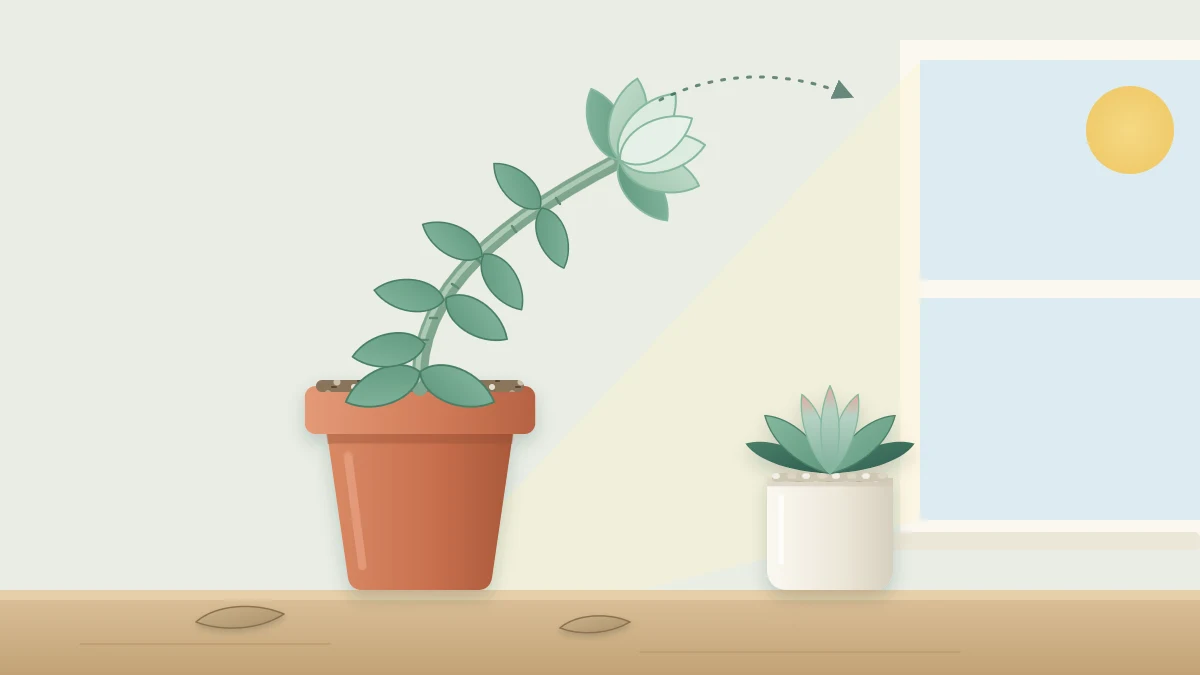
Leggy succulents start out as neat, compact plants. Then, over weeks or months, the center rises, the stem shows between the leaves and the whole plant leans toward the window. What was a tight rosette becomes tall and gappy.
The usual cause is too little light, and the growth it produces has a name: etiolation, or stretching. The plant is not dying, and often it is otherwise healthy. But the stretched part will not go back to how it was, so it helps to understand what is happening and what your real options are.
What etiolation is
A succulent that receives less light than it needs changes the way it grows. The stem lengthens faster than usual, the leaves are set farther apart, and they often flatten out or angle downward, which exposes more leaf surface. In effect, the plant spends its energy on reaching for a brighter spot.
The new growth is usually paler and softer than growth made in good light. Because the stem is long and thin, it bends toward the strongest light source and can eventually flop over under the weight of the top.
Early signs to watch for
Stretching is much easier to deal with when you catch it early. Look for these changes, especially in the newest growth at the center:
- The plant leans or tilts toward the window.
- A rosette that was flat and tight begins to open up.
- Leaves point outward or downward instead of curving up and in.
- New leaves are paler, or the plant loses the pink, red or purple tones it had when you bought it.
- Bare stem becomes visible between the leaves.
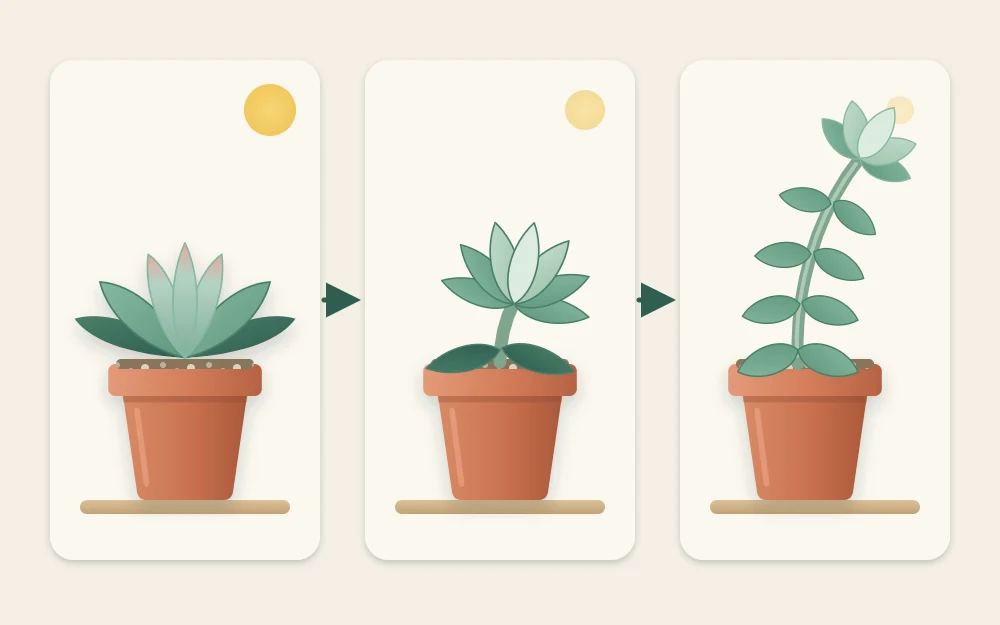
None of these is proof by itself. Leaves can also droop when a plant is thirsty or its roots are in trouble, and color fades for other reasons. Several of these changes together, in a spot away from strong light, make stretching the likely explanation.
Why it happens indoors
Light indoors is much weaker than it looks. Your eyes adjust to a dim room, but a plant cannot. Brightness falls off quickly with distance from the glass, so a shelf a few feet into the room receives far less light than the windowsill.
These situations are commonly associated with stretching:
- A window that faces away from the sun. In the Northern Hemisphere, a north-facing window gives the least light.
- A position well back from the window, or behind blinds or heavy curtains.
- Winter, when days are short and the sun is low.
- Shade from trees, buildings or a deep roof overhang outside.
Warmth, water and fertilizer keep a plant growing, and growth made in dim light tends to be stretched. That is why a plant can stretch quickly in a warm room in winter. For how much light different plants need, see the guide to succulent light requirements.
Not every tall succulent is stretched
Height alone does not mean a problem. Some succulents grow upright or trail by nature:
- Jade plants form thick, branching stems and become shrubby with age.
- Many aloes and some kalanchoes grow tall as they mature.
- Burro’s tail and string of pearls produce long hanging stems.
- Older rosette plants can slowly build a short stem as their lowest leaves dry and fall.
- A flower stalk rising from a rosette is long and thin but is not stretching.
The difference is in the spacing. A naturally upright plant in good light has sturdy stems and leaves set close together. A stretched plant has thin stems, wide gaps and often paler growth than the older leaves below it.
Stretched growth does not shrink back
Once a section of stem has lengthened, it stays that length. Moving the plant to better light does not pull the leaves back together.
What better light changes is the growth that comes next. New leaves at the tip form closer together and with better color, so over time you see a compact top sitting on a stretched section. Whether that bothers you is a matter of taste, not of plant health.
What you can do
Move it to brighter light, gradually
This is the fix for the cause. Choose a brighter window or a place closer to the glass. A plant grown in dim light burns easily, so increase the exposure in steps, as described in the guide to acclimating succulents to brighter light. Where no window is bright enough, a grow light placed above the plant is another route.
Rotate the pot
Turn the pot a quarter turn each time you check the soil. Rotating evens out a lean and keeps growth balanced. It does not make up for a spot that is simply too dim.
Accept the shape
A stretched plant can live for years. If it is firm, growing and standing up by itself, leaving it alone is a reasonable choice, particularly once the light has been improved.
Cut back the top and re-root it
For a rosette on a long bare stem, you can cut off the compact top with a short length of stem, let the cut dry for several days, and then set it on dry gritty mix to root. The remaining stump often produces offsets if it is left in its pot. Do this in the growing season, and only once the plant has a brighter place to go to.
Good to know
A stretched plant has had little light for a long time, so its leaves are not ready for strong direct sun. Moving it straight to a hot, sunny sill or outdoors can scorch it within a day or two.
Keeping new growth compact
Prevention comes down to matching the plant to the light you have. Rosette types such as echeveria are among the quickest to stretch indoors and need the brightest position available; the echeveria care guide covers their needs. Haworthias and snake plants cope with lower light far better.
Check the newest growth every so often, since that is where a shortfall shows first. In the darker months it can also help to keep the plant a little cooler and let the soil stay dry for longer, so it grows less while the light is poor.
Frequently asked questions
Can a leggy succulent go back to normal?
The stretched section of stem stays as it is, and the gaps between those leaves do not close. With more light, the new growth at the tip comes in compact again. If you want a tight plant, the usual route is to cut off the top and re-root it once better light is available.
Does a leggy succulent need more water?
Not because it is leggy. Stretching is linked to low light, and a plant in low light generally uses water slowly. Keep judging by the soil: water thoroughly only when it has dried through. Extra water in a dim spot tends to produce more weak growth and keeps the roots wet for longer.
Will a grow light stop succulents from stretching?
It can help where no window is bright enough, provided the light is strong enough and close enough to the plant and stays on for a good part of the day. Results vary with the lamp and the species, so watch the new growth. If it stays compact and well colored, the setup is working.