Succulent Care While You Are on Vacation
What to do with your succulents before a trip, what to tell a plant sitter, why watering gadgets are a poor fit, and how to assess your plants when you return.
Of all the houseplants you could leave behind for a trip, succulents are among the least demanding. They store water in their leaves and stems, and an established plant usually tolerates a dry spell far better than it tolerates wet soil. Good succulent care on vacation is mostly a matter of not overdoing the preparation.
What you need to arrange depends on how long you will be away, the season, and how small the pots are. For many short trips the honest answer is: nothing at all.
How long can succulents go without water?
There is no single number, because it depends on the plant, the size and material of the pot, the soil, the temperature and the light. As a rough example, a well-rooted jade plant or snake plant in a medium pot in a mild room may go several weeks without visible stress, while a tiny pot on a hot, sunny sill can dry out within days.
If you have had your plants for a while, you already hold the best information: how long each pot normally takes to dry, and how long the plant has gone between waterings before without wrinkling. If your trip is shorter than that gap, you probably do not need help.
Before you leave
- Check the soil a day or two before departure. If it has dried through and the plant is due, water thoroughly and let the pot drain completely. If the soil is still damp at depth, leave it. The guide on how to water succulents explains how to check.
- Empty every saucer and cachepot. No pot should sit in water while you are gone.
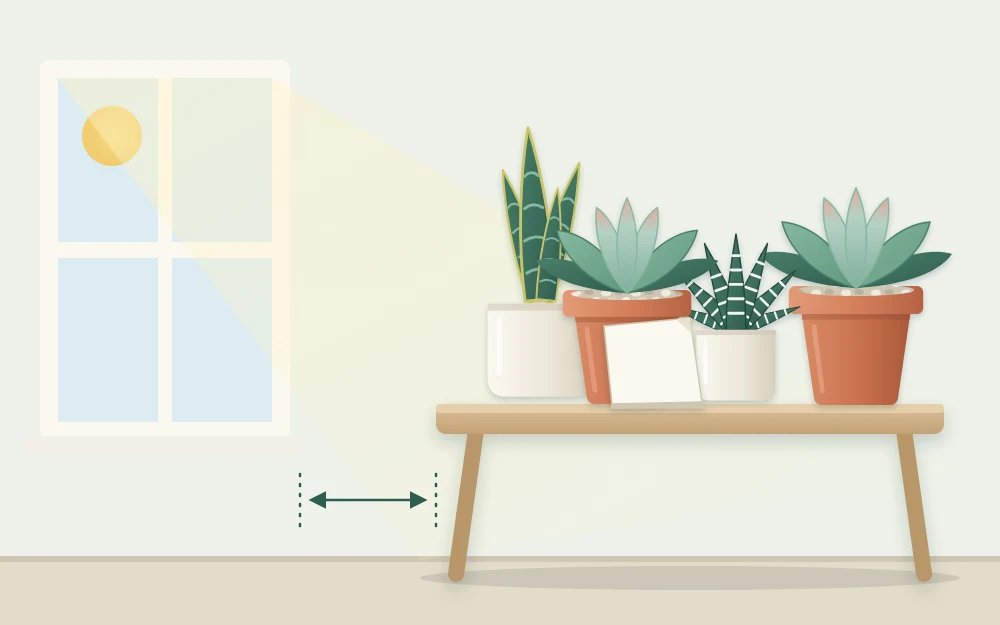
- Move pots back from hot glass. A plant that copes with a sunny sill when you are home to notice trouble is better off a short distance from the window, in bright indirect light, while nobody is watching. It will also dry more slowly there.
- Remove dead leaves. Dry leaves around the stem hold moisture and shelter insects.
- Look for pests. A few insects can become many in several unobserved weeks, so check leaf joints and stems and deal with anything you find before you go.
- Think about the room. If the heating or cooling will be off, consider how hot or cold the plants’ spot may get. Leave curtains partly open so the plants still receive daylight.
Good to know
Do not give a “just in case” soak to soil that is still damp. Extra water does not get stored for later; it only keeps the roots wet for longer in a home where no one is checking.
Short trips
For a long weekend or a week or so, established succulents in pots of a reasonable size generally need only the checks above. Come home, assess, and carry on as usual.
The exceptions are the ones listed further down: very small pots, young plants and hot weather. If any of those apply, treat even a short trip a little more carefully.
Longer trips and plant sitters
For an absence of several weeks, particularly in the warm growing season, a visit or two from someone you trust is the most reliable arrangement. Well-meaning sitters tend to overwater succulents, so clear instructions matter more than frequent visits.
- Group the plants in one place so none are forgotten.
- Ask the sitter to check, not to water on a timetable. Show them how to push a wooden skewer into the soil and how to judge a dry pot by its weight.
- Leave one written cue per plant. For example: “Water only if the skewer comes out dry and clean” or “Leave this one alone until I am back.”
- Say how to water. At the sink, thoroughly, then drain fully before the pot goes back.
- Give permission to do nothing. Tell them plainly that when in doubt, skipping is the better choice.
If nobody is available, most mature succulents in mild conditions will still come through a few dry weeks. They may look wrinkled and tired on your return, which is usually recoverable.
Why watering gadgets suit succulents poorly
Self-watering pots, wicks, water globes and spikes are designed to keep soil evenly moist. That works for thirsty leafy plants, but it is the opposite of the soak and dry cycle succulents need, in which the soil dries through between waterings.
Standing pots in a tray of water for the duration has the same drawback, only stronger: the lower part of the root ball stays saturated the whole time. Constantly wet soil is commonly associated with root rot, and you would not be there to notice early signs.
Plants that need more thought
- Very small pots, such as those 2 in (5 cm) across, hold little soil and dry fast.
- Seedlings, young offsets and newly potted plants have few roots and little stored water.
- Thin-leaved and trailing types generally store less than thick-leaved rosettes.
- Summer heat, especially in a closed room without cooling, speeds drying and adds heat stress.
- Outdoor containers face sun, wind and unexpected rain; move them to a bright spot sheltered from the midday sun and from downpours.
For these, a sitter is worth arranging even for a week or two. Moving small pots to a cooler, bright room out of direct sun also slows drying noticeably. The basics of indoor succulent care can help you choose a spot.
When you get back
Resist the urge to water everything the moment you walk in. Look first.
- Check each pot’s soil at depth. Some will be bone dry and others may still hold moisture.
- Look at the leaves. Wrinkled, thinner or softer leaves on a plant in dry soil are commonly associated with thirst; the guide to an underwatered succulent covers how to confirm it and what recovery looks like.
- Water the dry ones thoroughly, once, and let them drain. Do not follow up with extra waterings to make up for lost time.
- Inspect for pests again, and remove any leaves that dried up while you were away.
- Move plants back to their usual positions. If they spent weeks in lower light, return them to direct sun gradually over several days to avoid sunburn.
Plump leaves typically return within days of a good watering. A plant that stretched a little in lower light will keep that shape, but new growth should come in compact once it is back in its usual spot.
Frequently asked questions
How long can I leave succulents without water?
It varies with the plant, pot size, soil, temperature and light, so there is no fixed figure. Established, thick-leaved succulents in mild indoor conditions commonly cope with a few dry weeks. Very small pots, young plants and anything in summer heat dry out much sooner and deserve a check from someone.
Should I water succulents right before I go on vacation?
Only if the soil has dried through and the plant is due for water anyway. In that case water thoroughly a day or two ahead and let the pot drain fully. If the soil is still damp at depth, leave it alone; extra water keeps roots wet without helping the plant.
Are self-watering pots or water globes good for succulents while I am away?
Generally not. These devices are made to keep soil evenly moist, while succulents do best when the soil dries through between waterings. Soil that stays wet for weeks is commonly associated with root rot. Moving plants out of hot sun or asking a sitter to check them is a better approach.