Succulents in Pots Without Drainage Holes: Risks and Workarounds
Why a drainage hole matters for succulents, why a gravel layer does not replace one, and three ways to use a container with no hole, ranked from lowest to highest risk.
Some of the best-looking containers were never made for plants: a glazed bowl, a teacup, a glass jar, a tin. It is natural to want a succulent in one. The trouble is that succulents are among the plants least suited to pots without drainage holes, because their roots depend on soil that dries out fully between waterings.
That does not mean the container has to stay empty. There are three workable approaches, and they differ a great deal in how much risk they carry.
Why a drainage hole matters
When you water a pot that has a hole, the soil takes up what it can hold and the surplus runs out of the bottom. As it drains, air is drawn back into the mix. You can water thoroughly, which is the basis of the soak and dry method, and still have roots that are not sitting in water.
Without a hole, every drop you pour in stays. Any amount beyond what the soil can absorb collects at the bottom, where you cannot see it, and the lowest roots sit in saturated mix with no air. That is the condition most commonly behind succulent root rot.
There is a second, slower problem. Tap water and fertilizer contain dissolved minerals. In a draining pot, a thorough watering flushes some of them out through the hole. In a sealed container they have nowhere to go, so they build up in the soil as the water evaporates, sometimes showing as a white crust on the surface or the rim.
Why a gravel layer does not replace a hole
The usual advice is to put a layer of gravel or pebbles in the bottom “for drainage.” It sounds sensible, but it does not do what people expect.
Water does not move easily from a fine-textured material into a much coarser one. It tends to stay in the soil until that soil is saturated, and only then drips into the gravel below. The result is a wet zone sitting in the soil just above the gravel, and because the gravel takes up room, that wet zone is pushed higher, closer to the roots.
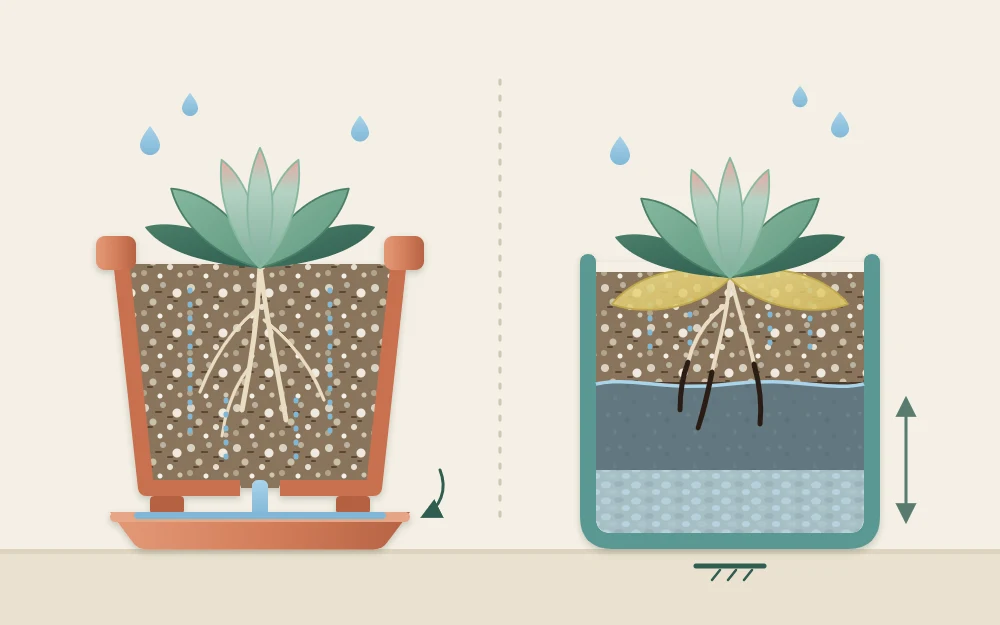
A gravel layer also does nothing about mineral buildup, and any water that does reach it stays there.
Best option: use it as a cachepot
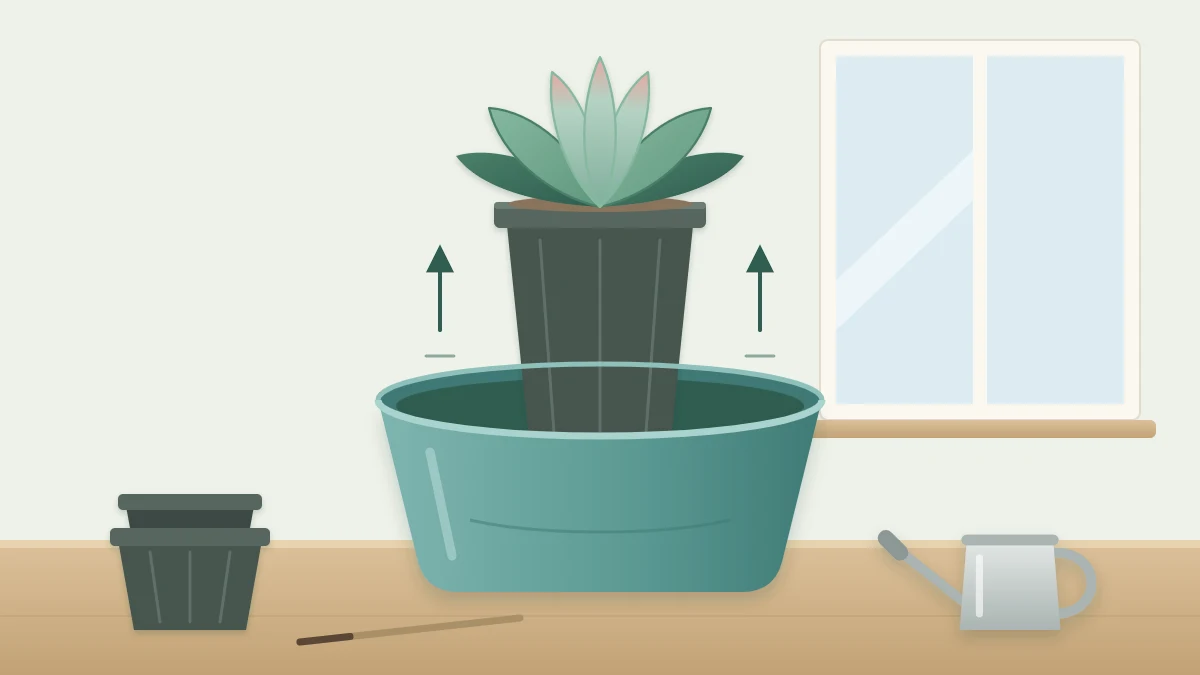
The lowest-risk way to use a container with no hole is not to plant in it at all. Keep the succulent in a plain pot with a drainage hole, such as the plastic nursery pot it came in, and set that pot inside the decorative one. Used this way the outer container is a cachepot.
- Choose an inner pot that fits with a little space around it, and sits low enough that its rim is hidden or nearly so.
- When the soil has dried through, lift the inner pot out and water it at the sink.
- Let it drain until it stops dripping.
- Return it to the cachepot.
If you water in place instead, tip out whatever collects in the outer container soon afterward. A top dressing of gravel can hide the rim of the inner pot if it shows. What to look for in the inner pot itself, including size and material, is covered in the guide to the best pots for succulents.
Second option: have a hole drilled
Many containers can be given a hole. The right bit depends on the material: bits made for glass and tile are used for glazed ceramic, porcelain and glass, while masonry bits suit unglazed terracotta and concrete. Metal and plastic take ordinary bits.
The general approach is a slow drill speed, light pressure, and water on the drilling spot to keep the bit and the surface cool, with the container resting on a soft, stable support. Follow the instructions that come with the bit and the drill.
Good to know
Wear eye protection, and gloves when handling a freshly drilled edge. Ceramic and glass can crack or shatter during drilling even when the work is done carefully, so do not attempt it on a container you could not bear to lose. If you are not used to power tools, ask someone who is.
Once drilled, the container behaves like any other pot. Thin glass and very small pieces are poor candidates; for those, the cachepot method or the option below is more realistic.
Riskiest option: plant directly and measure the water
Planting straight into a sealed container can work, but it leaves little room for error and asks for more attention for as long as the plant lives there. If you go this way:
- Use a very gritty mix, with a high share of pumice or perlite, so that it holds less water and more air.
- Pick a shallow, wide container over a deep, narrow one. A shallow layer of soil dries faster and more evenly.
- Water in small measured amounts. Use a spoon, a syringe or a small measuring cup so you know how much went in. The aim is to moisten the root zone without any surplus reaching the bottom.
- Check with a skewer before each watering. Push a wooden skewer to the very bottom and leave it for a minute. If it comes out dark, damp or with soil clinging to it, wait.
- Keep it out of the rain. A sealed pot outdoors fills up in one storm.
This is a deliberate exception to normal practice. The standard approach, described in the guide on how to water succulents, relies on water running out of the bottom, which cannot happen here. If you do add too much, tip the container carefully on its side, holding the soil in place, and let the excess run out.
Watch the plant as well as the skewer. Lower leaves that turn soft and translucent, or a stem base that darkens, are reasons to slide the plant out and look at the roots.
Glass terrariums and humidity
Glass containers add a further difficulty. Tall or narrow-necked glass restricts air movement, so moisture leaving the soil lingers around the plant, and the soil dries slowly. Closed terrariums are designed to hold humidity, which suits ferns and mosses and works against succulents.
If you want succulents in glass, an open, wide, shallow bowl is the most forgiving shape. Keep it out of strong direct sun, since glass can trap heat around the plant, and treat watering as you would for any sealed container: small amounts, checked at the bottom first.
Frequently asked questions
Can succulents survive in a pot with no drainage hole?
They can, but the margin for error is small. With no way out, any surplus water collects at the bottom and the soil stays wet for much longer. Success depends on a very gritty mix, small measured amounts of water, and checking the bottom of the pot with a skewer first.
Do rocks at the bottom of a pot help with drainage?
Not in the way most people expect. Water tends to stay in the finer soil until it is saturated before moving into the coarse layer below, so the wet zone ends up sitting just above the rocks and closer to the roots. The surplus water still has nowhere to go.
How much water should I give a succulent in a sealed container?
There is no fixed amount, because it depends on the size of the container, the mix, the plant and the conditions. Start with a small measured quantity, enough to moisten the root zone, then check the bottom with a skewer over the following days and adjust from what you find.