Fertilizing Succulents: A Light-Touch Guide
Succulents need far less feeding than most houseplants, and often none. Learn when a light feed helps, when to skip it, and how to spot and flush out a buildup.
Succulents come from places where the soil is thin, rocky and poor, and they are built to grow slowly on very little. That is why fertilizing succulents is an optional extra, not a core task like getting the light and the watering right. Plenty of healthy plants on windowsills have never been fed at all.
Still, a plant that has lived in the same pot for a long time can use up what its soil had to offer, and a small, well-timed feed can help. The skill lies in doing less than you think you should, and in knowing when to skip it altogether.
Do succulents need fertilizer at all?
Often, no. Fertilizer is not food in the way people tend to imagine. A plant makes its own energy from light, and fertilizer only supplies the minerals it uses to build new tissue. A succulent in weak light cannot use extra minerals, however much you give it.
That makes feeding the last thing to adjust, not the first. If a plant looks dull, pale or slow, check its light, its roots and how long the soil stays wet before you reach for a bottle. Fertilizer does not fix any of those, and it can make a struggling plant worse.
What fresh soil already provides
Most bagged potting mixes contain some nutrients, and many include a small starter charge of fertilizer. A plant moved into fresh gritty, fast-draining mix usually has what it needs for a good while, often for the whole of its first growing season in that pot.
For many small collections, the simplest routine is no fertilizer at all: you repot into fresh mix when the plant has outgrown its pot or the old soil has broken down, and the new mix does the feeding. Extra fertilizer matters most for plants that stay in the same soil for years.
When feeding makes sense
A light feed is reasonable when all of these are true:
- The plant is actively growing, with new leaves appearing at the center of the rosette or the stem tips.
- It sits in good light, so the new growth can stay compact.
- It is healthy, with firm leaves and no sign of rot or pests.
- It has been in the same soil for a long time.
Timing follows the plant, not the calendar. Many succulents grow mainly in the warm, bright months, while some do most of their growing in cooler seasons and rest in summer. The guide to how growth changes with the seasons explains how to tell which pattern your plant follows.
Choosing and diluting a fertilizer
You do not need anything special. A balanced houseplant fertilizer, or one that is lower in nitrogen than in the other main nutrients, is the usual choice. Nitrogen drives leafy growth, and too much of it tends to push succulents into soft, stretched growth that does not suit them.
Fertilizers formulated for leafy houseplants assume a plant that grows faster and uses more than a succulent does. The general pattern is to dilute well below the label rate given for other houseplants, and to follow the product label for everything else: how to mix it, how to apply it and how often it may be used. Never go above the label rate.
Good to know
Fertilizer products differ in strength and in how they are meant to be used. Read the whole label before you open the container, follow its storage and handling directions, and keep it out of reach of children and pets.
How to apply it
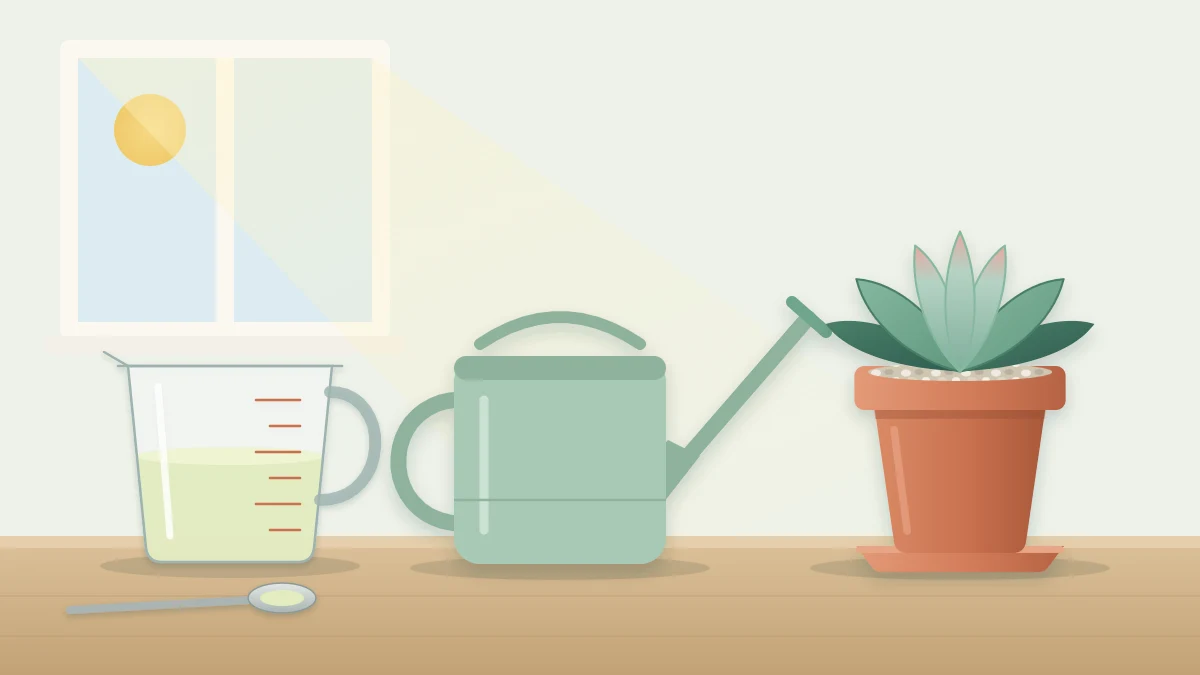
- Check that the plant is due for water. Feeding replaces a normal watering; it is not an extra one.
- Dampen the soil with plain water first. Fertilizer applied to bone-dry soil reaches the roots in a more concentrated form.
- Mix the diluted solution as the label describes, in a clean container.
- Pour it onto the soil, not over the rosette, and let the excess run out of the drainage hole.
- Empty the saucer afterward so the pot does not sit in the runoff.
A few light feeds across the growing period are plenty for most potted succulents, and many do well with fewer. If you are unsure whether a plant needs one, leaving it out is the lower-risk choice.
When to skip feeding
- During the resting season. A plant that is not growing takes up very little, so the minerals simply collect in the soil.
- Just after repotting. Fresh mix has its own nutrients, and disturbed roots need time to settle before they meet fertilizer.
- When the plant is sick. Soft or discolored leaves, damaged roots and pest problems call for finding the cause, not for feeding.
- When the plant is stretching. Etiolation is a light problem. Feeding a stretched plant tends to produce more weak growth, faster.
- Right after bringing a plant home. Growers usually feed their stock, so a new plant rarely needs more.
Signs associated with too much fertilizer
Overfeeding rarely shows up overnight. The signs below are commonly associated with it, but each has other possible causes, so look at them together and think about what has changed recently.
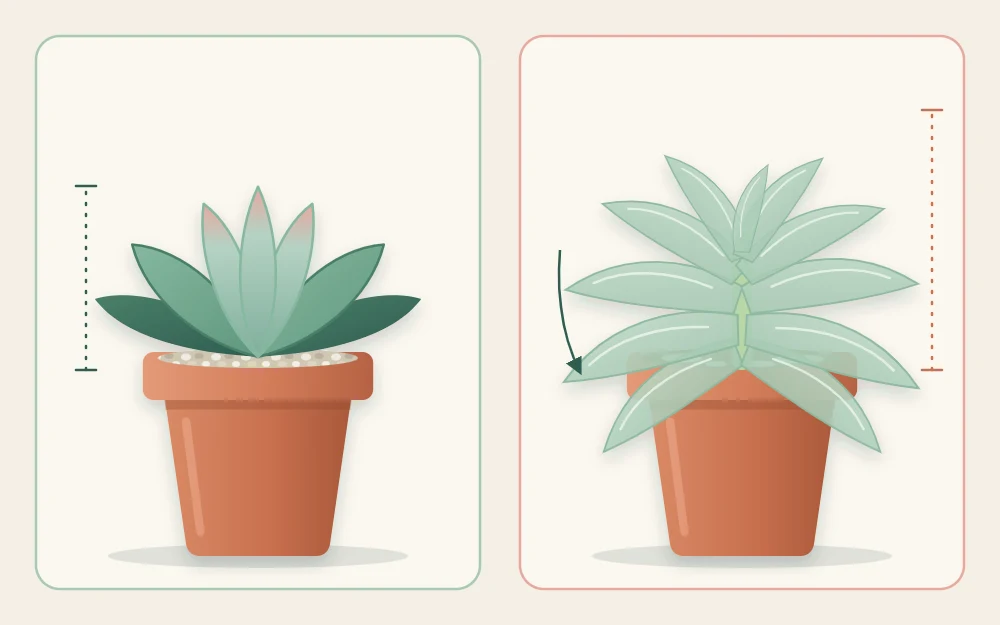
- Soft, fast, floppy growth. Leaves that are larger, paler and more widely spaced than before. Low light produces a similar look, so check both.
- A white or tan crust on the soil surface or the rim of the pot. Hard tap water leaves similar deposits.
- Brown, dried root tips or leaf edges. Built-up fertilizer salts can damage roots, though rot and drought can also be behind it.
Flushing the pot
If you suspect a buildup, stop feeding and flush the soil. Wait until the plant is due for water, then run plenty of plain water slowly through the pot, several times the volume of the pot, letting it drain freely from the drainage hole each time. Scrape off any loose crust on the surface first so it does not wash back in.
Afterward, let the soil dry through as usual before you water again. If the crust is heavy, or the soil stays wet for a long time after flushing, replacing the mix is often the better fix. Clemson Cooperative Extension covers fertilizing indoor plants in more detail.
Then give the plant time. A succulent that grows slowly, keeps its shape and holds its color is doing exactly what it should, with or without fertilizer.
Frequently asked questions
Do succulents need fertilizer to stay healthy?
Usually not. Succulents are adapted to lean soil, and fresh potting mix supplies nutrients for a good while. Light, watering and drainage matter far more. A light feed is mainly useful for a healthy, actively growing plant that has stayed in the same soil for a long time.
When is the best time to feed a succulent?
Feed only while the plant is actively producing new growth and is sitting in good light. For many succulents that is the warm, bright part of the year, but some grow mostly in cooler seasons. Hold fertilizer while a plant is resting, recently repotted, stretched or unwell.
What should I do if I have given too much fertilizer?
Stop feeding and, when the plant is next due for water, run plenty of plain water slowly through the pot so it drains freely from the drainage hole. Let the soil dry through afterward. If a heavy crust remains or the soil stays wet, replacing the mix is often the better option.